
Counting crores – India’s business jet market is about to boom
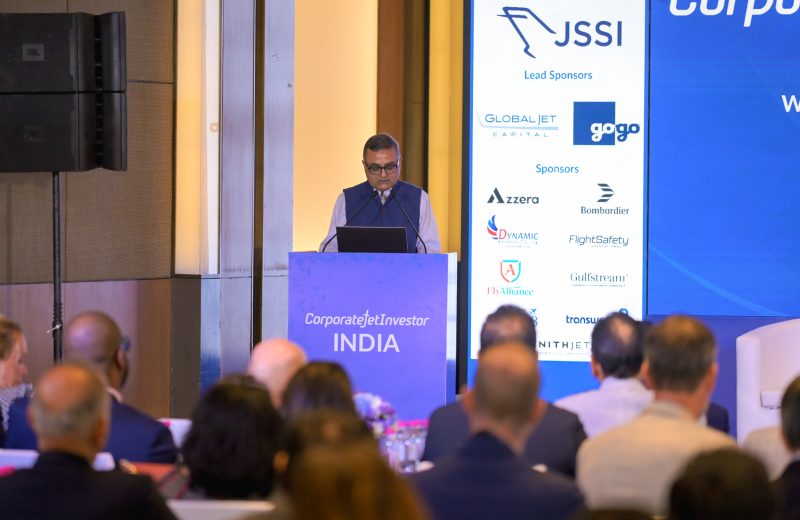
Director-General (DG) of the Directorate General of Civil Aviation (DGCA) Faiz Ahmed Kidwai delivers keynote speech at the CJI India 2026.
Economists spend a lot of time talking about the global productivity problem. There are so many easy wins. If only people could be bothered to notice them.
The US could free up millions of bartender hours simply by not asking white-haired grandparents for ID before serving them a Bud Light. The Indian subcontinent could free up trillions of keystrokes by revaluing their currencies. When you need to use crores (10m units) or lakhs (100,000) you know something is wrong.
The numbers in India are already hard enough to comprehend. One in seven of people on the planet is Indian. Delhi alone has 32m inhabitants.
There are also a lot of very rich people in the country. Altrata, a wealth data company, says that the country ranks 10th for people with more than INR249 crore or $30m (you see my point) in assets. That is 11,865 people. Forbes says India has 284 billionaires, third behind the US and China.
But there are fewer than 200 business jets based there. That is correct. There were more aircraft in Teterboro yesterday than in the whole of India.
The market potential is ridiculous. But this is not new. India has been tomorrow’s market for years, with tomorrow never coming. But this could be about to change. “Change is happening,” said Colonel Sanjay Julka, CEO technical, Club One Air, speaking at the first Corporate Jet Investor India conference last week. “The market is growing now with a lot more growth to come.”
India’s government and the Directorate General of Civil Aviation (DGCA), the equivalent of its FAA, is keen to help the market grow. “It is evident that India’s story is shifting from latent potential to execution and scale. This conference is about how stakeholders can transform optimism into bankable projects and sustainable operations,” said Faiz Ahmed Kidwai, director general of the DGCA.
Importing an aircraft into India has never been easy. The Reserve Bank of India maintains currency controls so sending a deposit takes longer. And then there is tax. A private aircraft buyer faces a 40% general sales tax. Some buyers pay this, but others create their own aircraft flight departments by applying for non-scheduled operator permits (or NSOPs). There are around 160 NSOPs. Some of these are well-run flight departments for large corporates and billionaires. Others were created just to avoid the tax.
Regulations have made it very difficult for third-party aircraft management companies to enter the market. This has also discouraged financiers. The DGCA is now working on policies to make true aircraft management and fractional ownership work.
Some 85% of attendees believe that India will have regulations allowing for traditional third-party management companies by the end of 2027. Most believe that there will be between 300 and 400 business jets registered in India by 2030.
“The Indian economy is going to grow the market. We need to create more services – charter, aircraft management, fractional, jet cards and the rest will happen. Boom!” said Jayant Nadkarni, MD, Flightshares.
Aircraft manufacturers and brokers are excited. They have seen an increase in demand from Indian customers over the past two months. This could be useful if we see a global slowdown. No fast-growing international market can replace the US, but it can make a big difference. Back in 2012, Chinese buyers helped OEMs by taking a lot of aircraft. India is also a more mixed market with opportunities for all manufacturers, not just large cabin aircraft like China. There are also a lot of pre-owned buyers.
“We’ve been working with the DGCA and the ministry to pave the way for both fractional and aircraft management companies and we are confident that we are seeing rapid changes coming,” said Sudhir Rajeshirke, Jubilant Enpro, the Textron and Bell representative in India. “We can accelerate new innovations.” Jubilant is also looking at launching an operator.
There are opportunities for international companies. “We kept seeing aircraft parts orders and we were like: wow there is a major demand and then we ended up selling aircraft into the region,” said Kevin Wargo, CEO, Fly Alliance. “We are now working on getting our own NSOP here in the country. We are working on our very first aircraft to be imported which will give us the ability to lease aircraft and continue with sales.”
Tax is still an issue but one of the biggest developments is the launch of the Gujarat International Finance Tec-City or GIFT City. GIFT City is a tax-free centre for banks, finance companies and insurers. It has been enthusiastically adopted by aircraft leasing companies, helped by a guaranteed 20-year tax holiday. Some 196 aircraft have been imported through GIFT City in the past few years – including 17 private jets and 17 helicopters. GIFT City can be used to import new aircraft.
“I see a great opportunity here for inviting the global business aviation community to establish their presence in the vibrant Indian business aviation market and create an international business aviation hub for the whole region,” said the DGCA’s Kidwai.
One other way to improve productivity is getting rid of economists. But they never get round to modelling that.
Subscribe to our free newsletter
For more opinions from Corporate Jet Investor, subscribe to our One Minute Week newsletter.