
Sino Jet: ‘It took a book to build’

The G700 can cover 7,750nm at Mach 0.85 or 6,650nm at Mach 0.90, with a maximum operating speed of Mach 0.935.
It began with a book of clients amassed during a former career as a banker with Morgan Stanley, today it is ranked as the largest business jet fleet in Asia for the seventh consecutive year. For founder and president Jenny Lau, Sino Jet — which began with 11 employees in a single office — it is the job of a lifetime.
The team has grown to over 400 with teams in Beijing and Hong Kong and satellite and subsidiary offices throughout China, in Singapore, North America, Dubai and Zurich. The fleet now sits at over 40 aircraft, mostly ultra-long range, of which Gulfstream is the most popular platform, with G650s, 650ERs and G700s making up more than 70% of the fleet. There are also a smattering of BBJs and ACJs. Total managed asset value is close to $8bn, according to Lau.

Lau previously worked for Morgan Stanley and Microsoft.
About 70% of Sino Jet’s business is aircraft management and maintenance. While approximately 20% is charter and buying or selling, and about 10% is FBO income, said Lau.
The most recent addition to the fleet is the G700, which, along with the rest of the fleet, speaks to the preference for ultra-long aircraft synonymous with Asian business aviation.
“The G700 represents the pinnacle of ultra long-range business aviation today: outstanding range, cabin comfort, mature technology and stable dispatchability,” Lau told CJI.
“It reflects strong and growing demand for international travel, especially in Asia,” she added. “With geopolitical tensions in the Middle East, Russia and Ukraine, some airspace is closing – not operationally friendly for flights from Asia to Europe or the US. The G700 gives passengers comfort and a one-stop flight without technical stops.”
Learning curves
Although many argue it has not yet realised its full potential, the Asian business aviation market is markedly more mature than it was when Lau arrived back in Asia after leaving the US and Morgan Stanley in the wake of the 2008 financial crisis. Largely thanks to the work of companies like Sino Jet.
Using the book of clients she had as a banker, one of which was a business jet owner, Lau returned to Hong Kong where she was tasked with finding him a good aircraft management company.
“I assisted him, and after seeing how other management companies operated, I felt maybe it was time for me to start my own operation,” Lau recalled. “The market in Asia was very young and immature. So I started a business, used my book of clients, and reached out to see who was interested in buying a jet. That’s how Sino Jet began.”
The jump from finance to business aviation is something even Lau herself calls a coincidence. One that has brought learning curves. The steepest of which has come in managing each separate stakeholder to get the right result.
“As a management company in Asia, we’re pretty much stuck in the middle between the authorities, the airports, the clients and the weather. If one element doesn’t work in our favour, it brings tremendous challenges,” explained Lau. “It took us a long time to build relationships with the local markets and airports, to visit CAAC [Civil Aviation Administration of China] and negotiate with them.”
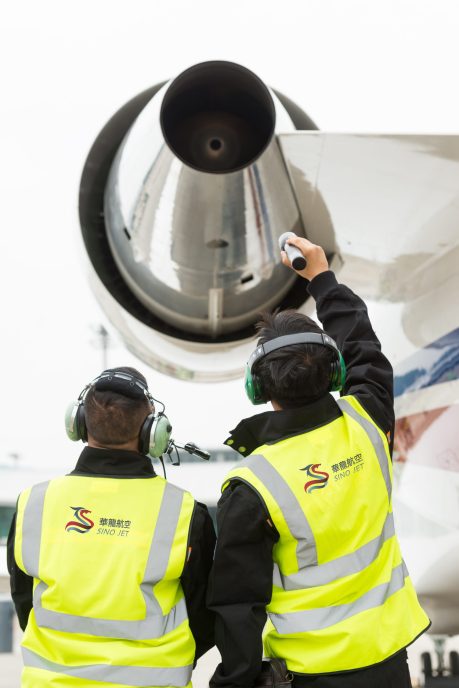
Sino Jet holds Part 39 Continuing Airworthiness Management Organization (CAMO) approval from the Cayman Islands Civil Aviation Authority.
Back in the early days of Sino Jet, Lau said it took about a week to apply for a permit to fly from Hong Kong to Beijing – losing the advantage of business jet flexibility. Over the years, after efforts with Sino Jet and the Asian Business Aviation Association, CAAC has relaxed its policies.
“They dropped the six-leg requirement for foreign registered planes, which was a big plus. But airports – business jet income might only be 1-2% of a busy airport’s revenue. We had to educate them: the service you provide to ultra high net worth clients who bring GDP to your city is more meaningful than their parking fees,” she said. “And educating clients too – some first-time owners think they can make U-turns in the sky. It takes time and patience to educate all stakeholders.”
The reverse of those challenges has been the opportunity for the Sino Jet team to grow — both in numbers and experience.
“The team and I have grown up so much,” said Lau. “We’ve become mature and flexible. When handling challenging tasks, we know what we’re doing and work as a close team – the synergy is there. We help each other out like brothers and sisters. Now when I see operational challenges, I don’t get a stomach ache anymore.”
When Lau first started, she had two or three phones on 24/7, afraid to miss any calls. Now Lau said she can relax, because the team is capable. “Internally, the strength we’ve built over the years has been most rewarding,” she added.
Continued leadership
Sino Jet’s operation is rooted in five strategic pillars: safety, global footprint, digital operations, worldwide service network and all-scenario service ecosystem.
Beginning with safety, Sino Jet was the first operator in China to get IS-BAO level three. The company has now renewed this accreditation and holds it for a further 10 years. “Safety is our number one focus. We highlight safety issues in monthly and weekly meetings and share stories so we can avoid risks,” said Lau.
Second is global credentials and global footprints. After COVID, the company expanded because its clients were moving out of Asia to places like London, Dubai and Vancouver. Sino Jet applied for a Cayman AOC, established offices in Singapore and Dubai, and provide diversified registration choices: San Marino, Bermuda, Aruba, Cayman, part 91 and N-registration. “We can accommodate any demands,” added Lau.
Third, digital operations. Many management companies are still traditional – “doing things by hand”, she said. Due to Sino Jet’s fleet size and shareholder background, it has invested heavily in digitalisation, including incorporating AI into its dispatch centre for real-time updates. “We’re building an application for clients to get quotes, view invoices, talk to their relationship manager making it more transparent and cost-efficient and avoiding human errors,” said Lau.
Fourth, it is the worldwide service network. In line with its efforts to build a global footprint, Sino Jet has FBOs in Macau, Chengdu, Nanchang, Guangzhou, and it is looking to develop more in Asia Pacific, Europe and the US.
Finally, the fifth pillar is the all-scenario service ecosystem. Sino Jet launched its “Business Jet+” strategy in December 2025, anchored by the Unionsky Curated Collection initiative (a comprehensive report launched by Sino Jet designed to map the premium lifestyle preferences of China’s high-net-worth population). With the release of the 2025 Unionsky Curated Collection List, Sino Jet has compiled a selection of hotels, golf courses and restaurants to offer clients a one-stop service experience.
“Some golf courses you can’t just book, you have to be a member – we partner to make it accessible. It’s not just managing their fleet, but ground services, air services, even cruises for family or company celebrations,” Lau explained. “We’ve also added low-altitude operations – helicopters, and we’re waiting for eVTOL manufacturers to get their TC and CAAC approval. We’re planning to make Sino Jet a one-stop solution for clients’ travel needs.”
Low-altitude economy
The low-altitude economy (LAE), known largely in the west as advanced air mobility, has been a significant focus of the Chinese administration for the best part of a decade. Every administrative region in China has invested in LAE to some extent.
Sino Jet recognised this momentum and began preparing about six years ago, said Lau. The company partnered with Hainan Airport in April 2026 to jointly establish Hainan Low-Altitude Mobility Company
According to a press release: “With Hainan as the strategic focal point, the company will deeply integrate into the national low-altitude economic development agenda, and work to build a new model for three-dimensional transportation in the Pilot Free Trade Port.”

The company also expressed interest in adding Aerofugia’s AE200 tiltrotor eVTOL to its fleet, signing an agreement with the developer in August 2023 to buy 100 of the aircraft. The AE200, which features a 200km (125mi) range, is currently in the final stages of airworthiness certification.
Lau said the company partnered with Hainan Airport because it is on an island which means less busy and less restrictive airspace.
“It’s an opportunity to run a mature business model there and then copy it to other cities. It would be more operationally challenging in Shanghai or Beijing because of airspace controls,” explained Lau. “We think three-dimensional intercity travel could lead the Chinese economy. I believe that eVTOLs will be the next trend for China to take the lead worldwide. That’s why we’re keen to partner with local municipalities and airports.”
China still in ‘recovery stage’
Despite impetus for the LAE growing in China, its business aviation market remains in the “recovery stage”, according to Lau.
Brand new sales are “still a bit slow” compared with other years, while more people are selling aircraft versus new buyers arriving. But there is strong demand in the pre-owned market, said Lau.
“The economy is picking up – manufacturing and real estate haven’t recovered to pre-Covid levels, but the stock market in China has been very active over the past year, and Hong Kong has been one of the busiest IPO hubs in the world,” she continued.
“There’s a lot of new money being created in this region, with strong demand for business jets. I’m optimistic about the Chinese market. Especially with President Donald Trump in Beijing recently – I feel there will be better business opportunities between China and the US, tensions relaxed. Business jet will have its springtime soon.”
Clientele changes are also a positive, said Lau. Ten or fifteen years ago, real estate business owners were the majority owners of Sino Jet’s fleet. Now video game and high-tech company founders – some only in their thirties – are becoming Sino Jet clients.
“That represents the direction of the China economy: shifting from traditional industries to technology, AI, games and batteries,” said Lau. “It’s a big shift in client demographics. It’s very positive – those companies are financially strong, and the clients are even more educated, younger, more adaptive to new ideas, more understanding of operational challenges.”
Growth opportunities
Lau has her eyes on multiple possible growth areas for Asia in the next five years.
Firstly, fractional ownership could gain further traction in the market. “In the past, you always saw single jet owners using the aircraft for themselves, maybe flying only 100-200 hours,” said Lau. “But new structures like timeshare – five or six owners owning one jet – could become a popular trend, expanding the fleet size and demand for private jets in the region.”
Regionally, southeast Asia is becoming a “very strong market”. Lau said Sino Jet needs to pay special attention there with additional business development focus. “Southeast Asia is like China in the post-2008 period – rapid growth, rapid demand for private jets. The service providers there are very new, just entering the market, still learning. It brings us an opportunity to put our footprints there and develop our market,” she explained.
Elsewhere, Lau believes further integration of digitalisation with full-suite services will enable operators who succeed in combining the two to differentiate from competition.
“Jet travellers want simplicity – just click one button and we process their travel needs, hotels, restaurants,” she said. “The opportunity comes when you align high-end services together. There are a lot of opportunities to connect the dots to become a comprehensive travel concierge. That’s what I see in the next five years.
“Although AI is helping us a lot, you still need people delivering services. I said to my staff at our annual dinner: perhaps lawyers and bankers can be replaced by AI, but we are service providers. We’ll probably be the last ones replaced by robots. We need quality people to understand quality service, deliver it in the most quality way and set the standard for the industry. That brings tremendous opportunity.”