
Looking for the sweet spot
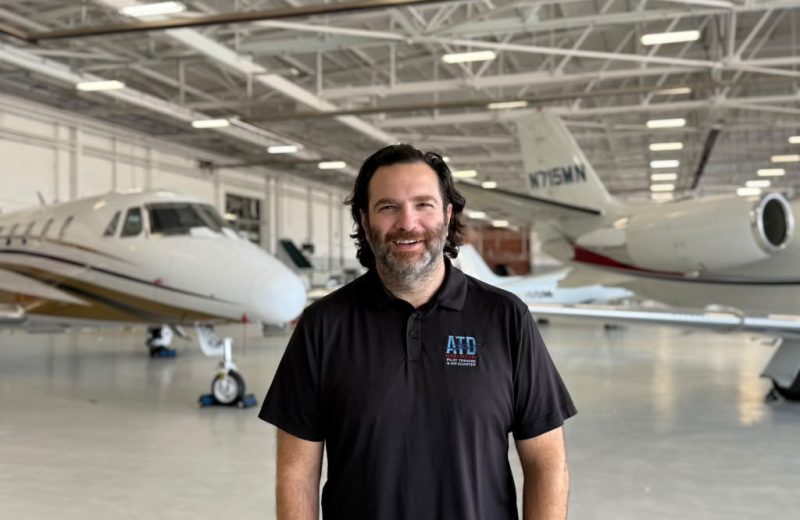
Atieh has acquired the controlling interest in Kansas City-based ATD Flight Systems.
Wealthy individuals have been buying business jets for a long time. But what has changed is who manages and flies the aircraft, according to Lute Atieh, investor and pilot. Atieh says he has positioned himself in that sweet spot.
Sitting at the helm of Northwest Missouri Aero Group, a private-equity syndicate of pilots, business operators, educators and investors, he has acquired the controlling interest in Kansas City-based ATD Flight Systems. This is the parent company of ATD Air Charter, an FAA Part 135 on-demand jet charter, ATD Aircraft Management and ATD Pilot Training, its Part 141 school. The charter operation comes with an ARGUS Gold safety rating. ATD was founded by William Hays in 1996.
Most small-business acquisitions are priced off trailing or future cash flows – the cornerstone of discounted cash flows valuation model in finance. But Atieh says ATD had more to offer.
“The real value for ATD Flight Systems lies in the Part 141 and Part 135 certificates,” he tells Aircraft Investor. He is referring to ATD’s self-examining authority and its three decades of operations without an incident.
Keara Neifach, daughter of founder William Hays, also remains a part owner and continues her leadership in operations. Atieh says Neifach draws on her background around flight-school administration and the relationships that come with it.
Combined with FlyTech, the school Atieh founded in 2023, the combined group now operates 25 aircraft with 75 employees across five locations in Missouri and Iowa.
“Cash flow did play into some of it. But not as much as a traditional business,” Atieh says when asked about how he valued the company. He admits that more than half of the company’s value was in its physical and mechanical assets rather than the real estate or the profit and loss.
At the time of acquisition, Atieh says ATD was cash-flow positive. “We knew even if we picked up the business [with a negative cash flow], in a year or two we could get it in the right position for success,” he says. “Most of the value went into the assets, both physical and mechanical.”
Atieh says the platform will now be a launchpad for a fleet build-out. ATD’s charter and management business has so far centred on Citation XLS+ and CJ-series jets. He plans to add two new jets this year with a Pilatus PC-12 on the horizon as well. Larger jets are planned down the line. And the financing is where, Atieh thinks, the structure gets interesting for investors.
Future jet purchases are planned through individual leaseback arrangements built around bonus depreciation and finalised as a triple net-lease programme. Atieh says this is: “structured to provide a truly cost-neutral ownership experience and reduce personal flying expenses while ATD manages, maintains and operates the aircraft”.
Explaining the model, Atieh says the investor places the aircraft into operation; claims accelerated depreciation while keeping a modest personal allotment of flight time. The rest of the time gets chartered out commercially.
“There’s no obligation,” he says. “At the end of the useful time, if the contract is working, we can continue it.” He claims an owner can expect a wet rate to be 30-50% under retail charter prices and that makes the arrangement work for both sides. He adds the fleet growth won’t be exclusive through leaseback arrangements. “Some of it will be with our investors in the lease. Some of it will be private to the group,” he tells us.
While he stresses the importance of fleet and certificates (from the acquisition of ATD), Atieh keeps coming back to its training pipeline as the structural edge to scale the platform.
ATD holds the examining authority on its approved Part 141 courses. A status, according to FAA data, only 15% of the certified Part 141 schools carry. This means qualified candidates can complete their check rides in-house rather than waiting for an outside examiner.
“My top priority is people,” he says. “I need more people to make us comfortable operationally. I want to build something cool.”
The capital for the deal came from the private-equity syndicate, all of whom have skin in the game. Atieh says he has a rough three-year horizon of investing into the business to get it where we want it.
“We’re going to really look at this as reinvestment for the next two or three years,” he says.