
‘Quit jumping’: Removing the hoops from aircraft registration
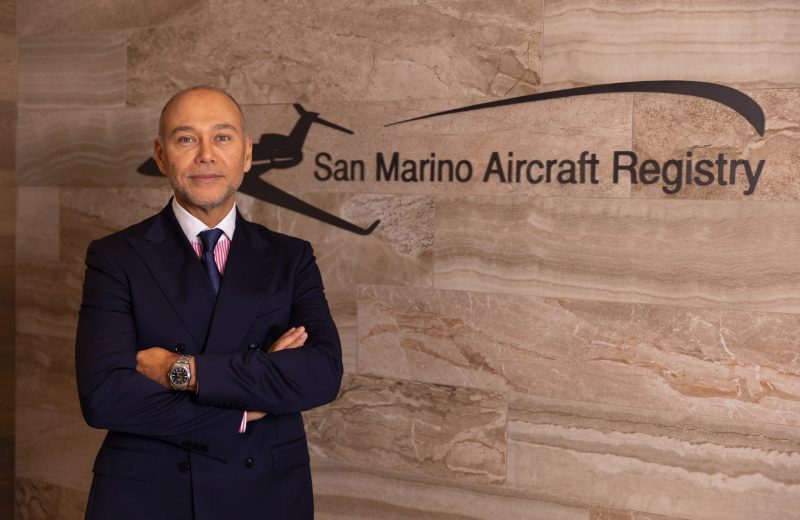
Although registering an aircraft is simple, the responsibility beyond registration is safety, said David Colindres, president, San Marino Aircraft Registry.
When Jorge Colindres established The Registry of Aruba in 1995 he did so with a goal in mind: to remove the bureaucratic hoop jumping he saw as the greatest inhibitor to aircraft owners.
From humble beginnings as the first privately managed Category-1 aircraft registry in the world as rated by the FAA, the company has grown into a group of registries including San Marino, Aruba and, soon, Gibraltar.
Through it all the philosophy has remained true, and the model of outsourcing administrative operations to an independent company has become the chosen structure for many young registries globally.
David Colindres, Jorge’s son, has been with the group for 25 years, first leading the Aruba registry out of Miami, US before taking on the leadership role in San Marino in late 2012. Over that time he said he has seen the issue of bureaucracy amongst established aircraft registries worsen.
“The clients we cater to, especially in offshore jurisdictions – but I think it’s more or less the same in many others, Italy, France, Spain – whoever buys a Global Express, a Gulfstream, a BBJ, an ACJ, is a world leader,” Colindres told CJI.
“The problem is that a majority of traditional civil aviation institutions worldwide, because they are public institutions, have bureaucracy in place. Like it or not, that’s how the system is. I don’t see them changing; I see them getting worse because they’re limited with human and budgeting resources,” he explained.
Added to this, Colindres said highly developed countries, especially in Europe, are becoming more adversarial to business aviation. “That creates boundaries,” he noted. “Within public institutions, they care less who owns the aircraft. It might be the richest person in France with an aircraft registered in France, but they don’t care whether he receives the service or not.”
But registering an aircraft is the “simplest thing”, according to Colindres. “It’s paperwork,” he added. That is why he believes the business model his father created to “eliminate bureaucracy” and give asset owners the quality of service their investment should command continues to go from strength to strength.
“These people are ambassadors for us. If you have heads of state, royal families, top executives of multinational companies choosing us, it makes an impact,” he said. “Why choose San Marino? It’s service. Today the main reason is service: having a balance between being fast, being responsive and the quality of what we deliver. I can be fast to reply to an email or a phone call, but it’s how I deliver that service. That’s what’s important.”
Maintaining the ecosystem
Although registering an aircraft is simple, the responsibility beyond registration is safety, said Colindres. Registries have a partnership with the civil aviation authority which ensures all aircraft registered are looked after from a regulatory standpoint, including annual inspections, pilot validation and certifying engineers. “Maintaining the entire ecosystem around the registration is the real responsibility,” he said.
Executing that takes resources. From administrative staff to safety inspectors and flight operations teams, “experience and knowledge is key”, noted Colindres.
“That’s why our group is different from others. I can’t say anything bad about the others, but the difference is that even if they go to the Isle of Man, Guernsey, Bermuda or Cayman – they’re all embedded into the public institution,” he explained. “Even though they sell service, they have limitations. Our business model eliminates bureaucracy because the registry is fully private.”
Colindres said agreement between the registry and the civil aviation authority of each jurisdiction is so strong that the “government knows we cannot perform if they don’t perform alongside us”.
In that sense, the registry and the civil aviation authority work in parallel. “I can sell and be reactive, but if I don’t have the support of the civil aviation authority and the authority doesn’t have the support of the government and the minister of transport, I can’t do it. Because ultimately the service provider of the regulatory service is the civil aviation authority,” he explained.
Colindres said people often ask him: Why are you opening a new registry? The demand is there is his answer. “We want to make sure Aruba and San Marino are kept boutique. If everybody wants San Marino, that’s excellent, but I can’t have thousands of aircraft in the registry, then I compromise service quality,” he said.
Counsel’s view
There are several reasons why San Marino is a reliable jurisdictions for the aviation community, Francesco Grassetti, founder, Wheels Legal Advice, and independent counsel to San Marino Aircraft Registry, told CJI.
First, the legal and regulatory framework is extremely clear and implemented with full consistency by San Marino’s civil aviation authority. Following the ratification of the Cape Town Convention in 2015, the general protection of leasing companies and financiers has been strengthened to the full extent permitted by Cape Town.
“That means a financier of a San Marino aircraft can exercise all the default remedies provided under Cape Town in an event of default,” said Grassetti. “There is no need to start long and complicated legal action before the national courts to repossess the aircraft, deregister and export it from the country, sell it and allocate the proceeds to the outstanding amounts owed by the borrower.”
Another important element is that San Marino recognises the validity of contracts governed by foreign laws. This is appreciated by the registry’s international clients, who tend to prefer UK‑ or US‑governed contracts in aircraft transactions, said Grassetti.
“Additionally, the registry itself is super‑efficient and business‑oriented,” he continued. “If requested, for an extra fee, they are open 24 hours a day, seven days a week. Any registration process, or applications for airworthiness certification or licensing of pilots and crew members, can be processed very quickly. They also have a network of airworthiness inspectors located across all five continents.”
Value retention
Taking in discussions at a recent conference featuring major dealers and brokers, Colindres said he was pleased to hear that San Marino came in the top ten of all registries for aircraft value retention. “The only offshore registry in the top ten,” he noted. “Any second-hand aircraft that goes onto the market, if it’s a T7, brokers and dealers like it because they know the aircraft has been well-maintained.”
Dealers and brokers don’t want to sit on a deal for two or three months because the pre-purchase inspection (PPI) reveals hundreds of problems because the authority behind it wasn’t doing its job. “In San Marino you can close a transaction within 30 days because the aircraft is so well maintained,” said Colindres.
“Operators love it too,” he added. “Most operators manage the aircraft and also assist the owner to buy the next one and sell the current one – it’s all part of the package. It keeps the ecosystem moving without bureaucratic delays. It’s a win‑win: the owner is happy, the operator is happy, everybody makes money.”
Choosing a jurisdiction
Top of the list when choosing where to set up a registry is government structure and political stability. A close second is to make sure the jurisdiction has corporate services, something most UK overseas territories or crown dependencies do well.
In San Marino’s case, although did not have corporate services established, it had something others didn’t: “it was going to be the first aircraft registry not belonging to a kingdom,” said Colindres. “That gave us, from a regulatory and legal standpoint, the ability to adapt quickly,” he added.
San Marino is also a direct contracting state to the International Civil Aviation Organization (ICAO), so the registry can move quickly with any amendments or changes it wishes to make. “Being part of a kingdom always involves bureaucracy between the territory and the metropolitan state – whether it’s the UK or the Netherlands – and many decisions can’t be made at the overseas territory level,” explained Colindres.
The launch of San Marino’s registry was not without its challenges. “For example, English was limited,” he said. “That meant finding human resources who could speak the language was a challenge, legal services presented a problem too. But slowly we managed all the hurdles.”
Today, among all the so-called offshore registries, San Marino is the largest. However, size isn’t as important as being “the most reputable”, said Colindres. “I think San Marino is the most reputable because of its service and safety record. Our ICAO score is about 98%. I don’t think any other small territory competing with us has ever achieved that,” he added.