Jet Aviation launches drone-based AI aircraft inspections in the US
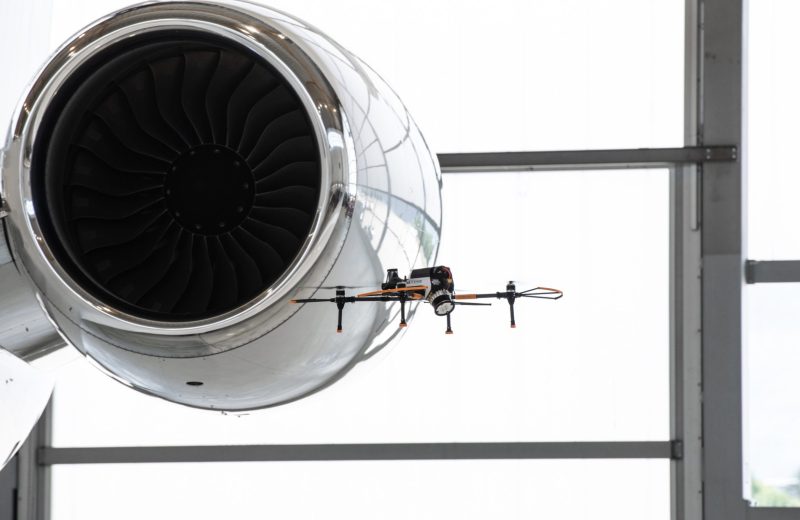
The technology is available for a wide range of business jet and narrow-body aircraft types, with new types able to be added in three steps.
Jet Aviation has begun offering drones using artificial intelligence (AI) technology for non-regulated inspections in the US.
The inspection reports can be used to enhance the accuracy of existing services such as pre-purchase-inspections (PPIs), or inspections in insurance or warranty cases, according to the company.
David Best, senior vice president regional operations and general manager, Americas said: “Our team is committed to listening to, and working closely with, our customers to grow our regional offering in ways that make a real difference to the owner and operator experience. The drone and AI technology offers our managed and FBO customers additional peace of mind, providing an accurate, comprehensive, digitised report of the exterior of the aircraft for their records now and in the future.”
The service is available to customers in the US either at a Jet Aviation facility, or through dispatching a trained technician to another location, dependent on local airport and hangar requirements.
It works by analysing the visual record of the aircraft to identify potential anomalies which are then confirmed by an inspector. The inspector also identifies if the AI analysis raises any false positive findings, allowing the technology to continue to learn and become ever more accurate. The findings are mapped on a 3D model of the aircraft and listed and recorded in a digital report.
The technology also compares current inspections with any past inspections to identify new findings, and is able to assess placards and markings status on certain aircraft types.
Jet Aviation first introduced automated drone and AI technology for inspections at its MRO hub in Basel, Switzerland, in 2023, in cooperation with AI drone specialist Donecle. In 2024 the process was approved by the Swiss Federal Office of Civil Aviation (FOCA) for General Visual Inspections (GVIs) by images.
The technology is available for a wide range of business jet and narrow-body aircraft types, as well as a growing number of wide-body aircraft.
Leslie Cheshier, vice president, Owner and Charter Services told CJI: “A fixed-wing or rotary-wing aircraft type that is not currently in the drone capability, can be added in three steps; acquiring the platform shape using a static scanner to create a 3D dot cloud and the 3D model to program the automatic drone flight, before validating against the physical aircraft.”
Breaking from visual inspection tradition, Cheshier said by using drone and AI technology Jet Aviation can enhance visual inspections by creating an “accurate and efficient” digital report of a customer’s aircraft exterior.
“As the drone takes pictures of almost all external surfaces it gives an impartial proof of the aircraft status at the time of the inspection. The customer can then gain access to all images of their scanned aircraft, as well as a digital report, via a dedicated drone,” she explained.