
CJI Magazine: ‘We win by working together’
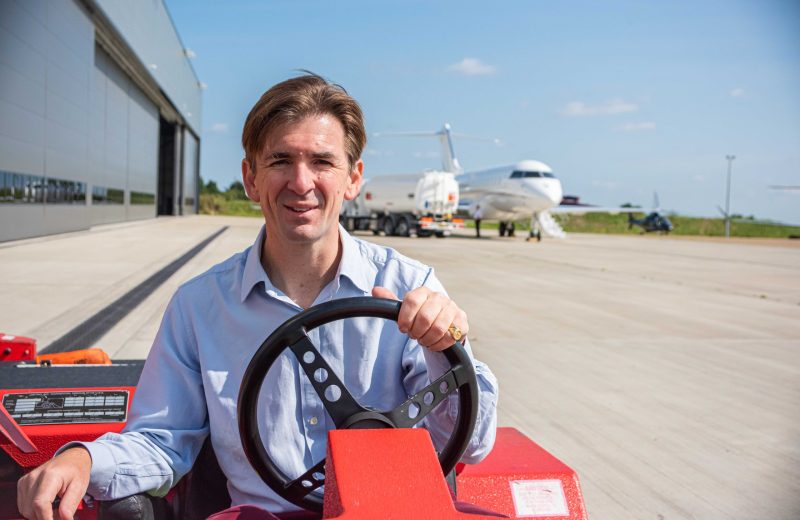
Robert Walters finds release from the pressures of London Biggin Hill Airport by spending time under sail.
Sailing helps Robert Walters, reset and readjust after the demands of his role as commercial director, London Biggin Hill Airport. Continuing our CJI Magazine series Out of Office – charting how private passions inform business life – we ask him to explain his love of life under sail.
It started with a submarine. Robert Walters’ grandfather served as a Royal Navy submariner during World War 2 and spent his retirement in sailing craft cruising the scenic waters of the River Deben in Suffolk, Eastern England and the North Sea. From this was born his grandson Robert’s passion for sailing – learnt in childhood and now delivering business benefits in his role as commercial director, London Biggin Hill Airport.
“My grandfather’s love of sailing and his fascination with the water got drilled into my father at a very early age, and has since passed on to me,” explains Walters. After learning the ropes (properly known as sheets) in Britain, Robert and his brother graduated to the prestigious Pleon Yacht Club, on Marble Head, near Boston, Massachusetts during summer holidays in the late 1980s and early 1990s.
“It was an amazing experience sailing six days a week,” he recalls. It was also notable for the youth of the sailing instructors – a tradition within the US’s oldest junior sailing school founded in 1887.
“We joined classes of 10- and 11-year-olds being taught by 18-year-old sailing instructors,” he recalls. “It was that full immersion in sailing, in very supportive seaside surroundings, that really ignited my passion to continue to learn and to get out on the water.”
Those skills were reinforced back in the UK by attending a school with strong Royal Navy connections. The school sent its pupils to a sailing club run on the navy’s base at Portland Harbour, Dorset on the UK’s southwestern coast. Long afternoons were spent honing racing skills on dinghies such as the Lark and Bosun.
Passion for racing
From that Walters graduated to bigger boats. His passion for racing was again family inspired. “For a number of years my father raced successfully a 30ft, One Design keelboat known as an Etchells.” (Robert’s father Andrew Walters is chairman of London Biggin Hill Airport).
So, it was in both home and foreign waters that Walters learn the skills of rigging, setting and trimming sails, reading potentially treacherous coastal sea conditions, captaining and helming crew boats. But the business benefits of time under sail extend far beyond the ability to tie sheepshank knots and instructing crews when to tack or gybe (turning the boat through the wind), he says.
Captaining yachts – particularly when racing – delivers a rich set of skills that pays off in the board room. “There’s a whole range of benefits arising from time afloat that includes: teamwork and communication, leadership, adaptability and problem-solving together with patience and perspective.” To that list, he also adds self-reliance and environmental awareness.
Teamwork on the water is not optional – it is a key requirement for running a safe and efficient boat. That becomes even more important under the pressured environment of yacht racing, says Walters. He talks of the camaraderie inspired by the collective endeavour of running a small yacht in often challenging sea and weather conditions. Of working together to fine tune the sails to exact that last (potentially race-winning) push of power.
‘Communicating in the right way’
Eventually communication on a racing boat becomes intuitive. “You’re thinking all the time about what your crew is doing and constantly getting feedback from them about how the boat is feeling and assessing what needs to be adjusted. You’re also having to keep your head outside the boat to be aware of your surroundings,” he explains. But no one should conclude the cockpits of racing boats are full of chatter. “Often, all of this is happening almost subliminally. The most successful boats are some of the quietest boats because if you are communicating in the right way, your crew will know what you want before you’ve told them and vice versa.”
Close kin to teamwork is leadership. Sailing offers the opportunity to hone leadership skills in the cramped cockpit of a racing yacht. The ability and (importantly) willingness to listen to your crew, to direct team players and to forge a close-knit team that can operate a peak performance under pressure have obvious benefits in business life. It’s not just the ability to direct the team.
The ability to read people and to listen to their perspective is key, says Walters. That means knowing their strengths and weakness – knowing when to give them the independence to resolve problems on their own and when to intervene to offer support.
Fast decision making
Another direct parallel between yachting and running a business as complex as London Biggin Hill Airport is the need for problem solving based on the flexibility to review alternative potential solutions. On the water, things go wrong – winches break, rigging fails and hulls can leak – often in the very worst of weather conditions. Such problems demand clear-thinking, fast decision making and the ability to co-ordinate a rapid response from crew members.
Translated to the boardroom, that means identifying and remedying problems quickly. It’s the ability to rapidly triage every new threat or opportunity – to decide how urgently action is needed and to respond accordingly. Whether in the boardroom or at sea, there’s little incentive to put things off, to delay decisions or – the worst policy of all – to let destiny decide the outcome.
Walters puts it like this: “Sailing teaches a deep perspective of constantly changing environments. That helps to mould your mind into a way that is well suited to a fluid operational environment when you come to work at Biggin Hill – a business operating with a tremendous number of moving parts.” Those moving parts at London Biggin Hill Airport include more than 70 firms – from Bombardier to Formula One – which call the airport home. All told, about 1,700 people work in various businesses on the airfield.
“As part of the executive team, we have responsibility not only for our own staff, but also responsibility for everyone else on the site too,” says Walters.
Given sailing’s similarity to aviation, it’s no surprise that technology sometimes transfers between the two. “Sailing is a great driver of innovation for aviation. It’s not just aerofoil technology,” he says. “Some of the boats taking part in last year’s Vendée Globe solo round-the-world sailing event carried specialist equipment that will drive significant innovation, not just in the sailing – in transportation and aviation too. There’s a huge crossover. It’s all about understanding of the air – the wing is a sail and a sail is a wing.”
But the business and technology benefits of sailing are not the whole story. Important too are the restorative power and simple pleasures of family time spent under sail. Running a boat, even a small dinghy, demands concentration – particularly when you are racing, he says. There’s no time to think about the pressures of work, of that next meeting of that next Teams call.
Problems melt away
Work problems melt away (at least for a while) as you concentrate on harnessing the elements of wind, water and tide to drive your boat over the finishing line. With that concentration comes a special release and relaxation from long hours spent at work.
Sailing is also a grand way to reconnect with family without the trappings (or entrapments) of modern life. “In a boat, no one is checking their i-phone for social media messages,” says Walters. “It’s pure family time alone with the wind, the water, the other elements and each other.”
So, an inherited passion for sailing, that started with a submarine, has paid off for Walters both in the board room and in enjoying family time on the water. “One of the most empowering things that sailing teaches you is that we are all pawns in the natural world and subject to its elements. We can win only by working together.”
Corporate Jet Investor H1 2026 magazine
This article was first published in Corporate Jet Investor H1 2026 magazine. Click this link to read the full digital version of this article or sign up for your free hard copy of the magazine here. The full version reports how London Biggin Hill Airport sponsored British sailor Pip Hare’s entry in the 2020-2021 Vendée Globe Challenge yacht race. There’s more too on the race-winning yacht designs of Skip Etchells.
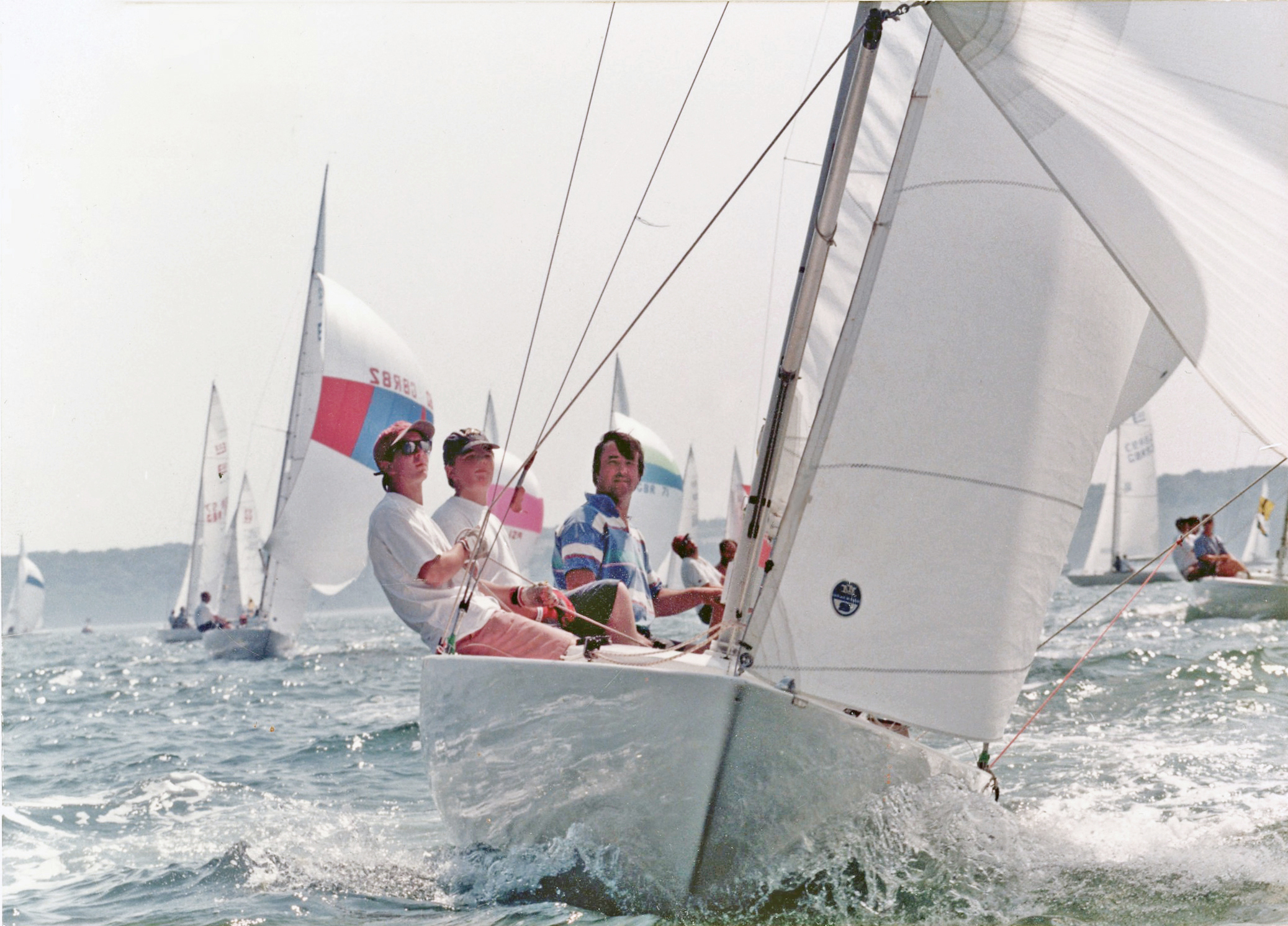
The Walters family afloat in days past. Andrew right helms the one-design keelboat with brothers Robert (left) trimming the sails and David.