
A Luminair-y for European charter
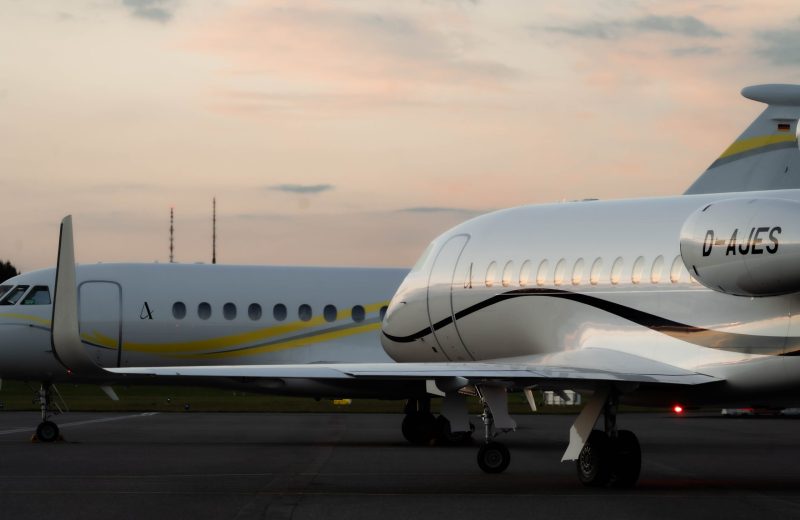
When the radios began to buzz with air traffic controllers offering congratulations as LUMINAIR’s first flight traversed the skies over Germany in late 2024, the reality of founding Europe’s newest charter operator truly dawned on Algernon Trotter and his fellow co-founders.
Fast-forward 17 or so months later and LUMINAIR has nine aircraft online, with five more due before year-end and a further six super-midsize new deliveries by second-quarter 2027. The company’s broker-exclusive model, built upon the Air Hamburg principles of high utilisation, trust and a “man’s word is his bond”, has seen the operator rapidly expand in its short life.
Arriving here has been a journey 16 years in the making for LUMINAIR CEO and co-founder Trotter. He left university at possibly the “absolute worst time” for aviation in the wake of the 2008 financial crisis, which cut short his aspirations of becoming a Royal Air Force cadet.
Aviation being the relationship-driven business that it is, fortunately Trotter “knew someone who knew someone” that worked at the British Business & General Aviation Association. Through that he landed an internship at a business based in Buckinghamshire, UK. The county, known affectionately as Leafy Bucks, with its rolling hills and green meadows is probably exactly what tourists imagine when they picture “ye olde English countryside”. True to form, Trotter’s office was once used as a set on Midsomer Murders.
“That summer internship was huge for building contacts. Afterwards, I got a job at PrivateFly in St Albans with Adam Twidell,” recalled Trotter. “I think I was employee number four or five. Alongside Adam and the rest of the team, we built up a strong charter brokerage business from almost nothing between 2010 and 2014.”
It was that experience that Trotter said that formed the basis for his attitude and work ethic that defines his career to this day.
“I remember having to teach myself almost everything,” he said. “There were only three brokers working around the clock. Back then, in 2010-11, there wasn’t really a concept of working hours – you just did the work. You had to be hungry and fight for it. That period really shaped me. It instilled that drive and hunger, which got me to where I am today. I’m immensely grateful to Adam for giving me that chance.”
Eventually Trotter was promoted to head of operations, before leaving in 2014 to move to Air Hamburg. It was in Germany that he defined the second pillar of his philosophy for running a sustainable charter business: the high utilisation model, operating private jets like an airline.
“In my view, maximising utilisation and efficiency is the only real way to make money in this business. That experience from 2014 to 2023 really defined my approach,” he said. “My mum always had this mentality of JFDI – “just f***ing do it” – and Adam reinforced that. It’s something I pass on to my team now. At the end of the day, the work only gets done if you sit down and do it.”
Seeing an opportunity
LUMINAIR’s existence is thanks collective efforts of its founding team made up of Trotter, fellow CEO David Bergold, chief operating officer Alexander Stevens and chief experience officer Julia Feddern, all of which are Air Hamburg alumni.
“David and I, along with a colleague called Wim, worked at Hamburg from 2014 through to its sale to Vista. We built a large sales and post-sales ‘flight care’ team,” said Trotter.
At Hamburg, sales drove “everything”, from scheduling and operations to even influencing maintenance planning. “By the end, David and I were running a team of about 45 people handling all of that,” he explained. Fellow co-founder Stevens came up through the pilot side and moved into compliance, so he understood building an air operator certificate (AOC) “inside out”.
“When Vista acquired Hamburg, there was a shift in mentality. Some aircraft owners—many of them German—preferred the Hamburg way of doing things,” said Trotter. “We saw an opportunity to rebuild that model. Our idea was simple: if you build it, they will come. We wanted to create an AOC based on high utilisation, strong relationships and fairness, particularly with brokers.”
The key is efficiency. Being able to say no to certain trips allows you to say yes to better ones – minimising empty legs and maximising revenue hours, said Trotter. “That’s how owners make money,” he added.
LUMINAIR secured initial funding from three of Air Hamburg’s aircraft owners in 2023 and after many months of work to build the AOC, began operations in late 2024 with 12 employees and one Cessna Citation XLS. “The ‘if you build it’ idea actually worked. That was one of the few bets in my life that paid off exactly as planned,” said Trotter.
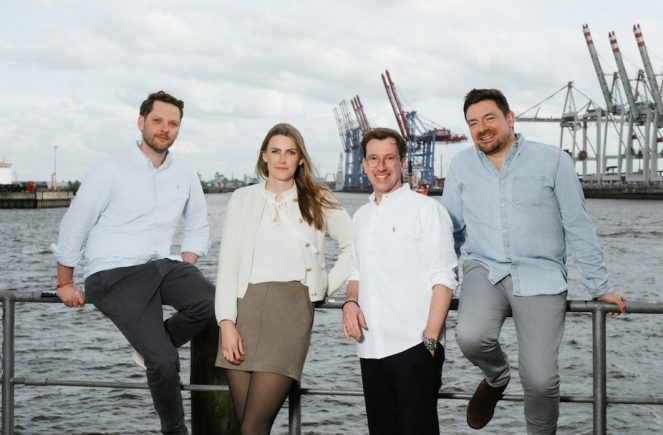
The founding team. (L-R) Alexander Stevens, Julia Feddern, David Bergold and Algernon Trotter.
Team expansion
It might only be a year-and-a-half ago, but things move fast at LUMINAIR. When this is published it will almost certainly have hired more people, but at the time of writing (March 30th) the team is made up of about 140.
Trotter, who has sat in at least 50 interviews for potential applicants, said the company “handpicks” its staff, with a particular focus on crew.
“I think all of us had did a lot of recruitment when we were at Air Hamburg. David, Julia and I, we must have recruited at least 50 people in our time there so it’s nothing new to us. We’ve developed really strong teams, we’re still expanding rapidly, we are still looking for crew members and people in the office across the board, but we have this momentum and people love momentum, we see that,” said Trotter.
He added that anyone with that “JFDI mentality” can bring their own influences to the business. “There’s nobody at the senior management level of LUMINAIR that’s stepping in your way, good ideas are accepted and encouraged.”
‘Be kind, it works!’
Asked to define LUMINAIR’s value proposition, Trotter said he always starts with core values. “Kindness. It sounds simple, but it goes a long way,” he noted.
“We focus on flexibility and relationships,” Trotter continued. “We don’t steal clients from brokers – we send them back with the broker CC’d. We try to be fair on pricing, flexible operationally and relationship-driven. That allows us to secure business, maximise utilisation and ultimately deliver returns for aircraft owners. It’s a cycle that works for everyone.”
It is that broker-led model that empowers LUMINAIR to act in the best interests of its clients, investors and itself. In short, Trotter calls it the “power to say no”. He uses the example of a European charter fleet which is booked up from Monday to Friday, except for one gap in the schedule.
“Let’s say your Falcon 900 lands in Malaga on the Tuesday, and on the Thursday you’ve got a must-do departure out of London. You can’t switch anything around and you have to perform this ferry trip,” explained Trotter.
“Now, as a retail focused business, what’s gonna happen? Well on the Monday your client’s going to call you and say, ‘hey, I need a heavy jet to fly from Oslo to Marrakesh’. The exact opposite of what you need to fly on your empty leg. It creates two further empty legs. Your client has a fixed fee. You cannot ask them for more money, even though it barely fits in your schedule. There’s no way that you could, even if that customer normally has a very profitable rate, make money on that trip.”
Conversely, as a broker-only focused business, when that request comes in for Oslo to Marrakesh, Trotter would say: “This is not our trip this time. This is one for one of our colleagues.”
It even leaves the door open for the “perfect trip to come in”, he added. “Continuing with my example, a trip from Palma to Paris comes in and they book it at a very good empty leg rate. The client is happy, the broker is happy and we are happy. We’ve only been able to do that because we could say no, if you have retail clients you can’t say no.”
‘Conveyor belt fleet’
Offering both its clients and itself “optionality” is the focal point of the LUMINAIR’s fleet building strategy. Beginning at the Textron Citation XLS, the operator offers the Falcon 900 as a step up and finally the Falcon 7X for ultra-long missions. Before long it will also sandwich a new super-midsize aircraft in between the XLS and Falcon 900.
“It is super simple. You cover all of your market segments, but what you enable is a series of efficiencies that means you can upgrade each booking,” said Trotter. “Say my light jet has that Palma to Paris empty leg I talked about, you just upgrade that flight from the XLS onto the super mid-sized jet. In doing so, that client is happy, they’ve got an upgrade, plus we filled the empty leg at a price that we are comfortable with.”
READ: LUMINAIR welcomes first 7X to fleet
The benefits continue to stack, added Trotter. “You gain the availability back on your smaller aircraft. So you can sell that again. Then you can keep doing that more, right? Let’s say you have a super-mid trip that fits perfectly on the Falcon 900. Again, this can be upgraded. The pricing works. The efficiencies work well too.
“You create this inter-modality within the fleet. That’s the reason why we’ve gone for this very structured four types, super light jet, super midsize jet, heavy cabin and ultra long range. It’s like a conveyor belt – you can shift demand where it fits best.”
Midnight in UAE
The momentum-fuelled enthusiasm surrounding LUMINAIR appears difficult to dampen, but that doesn’t mean certain challenges haven’t threatened to.
Foremost is the scramble to get its aircraft out of the Middle East after the outbreak of conflict at the end of February. Trotter said when the first strikes hit the United Arab Emirates, LUMINAIR had two 900LXs on the ground at Dubai International Airport and Dubai World Central.
“One had its engines running; we had to shut down when they closed the airspace,” said Trotter. “It was a nerve-wracking three or four days with six crew members and two aircraft stuck. We worked closely with the teams in Dubai, and the moment the airspace opened slightly, in the middle of the night, we got both aircraft out.”
LUMINAIR is also in the double digits for repatriation flights out of the Middle East following the outbreak of conflict.
Over the past fortnight, the operator has begun “normal” flying in out of the region, confirmed Trotter. “Being a young, flexible business means we can adjust quickly. We adapt and manage risk carefully. We don’t shy away from operating in challenging regions, but we make informed decisions with crews and security teams,” he said. “You can’t bury your head in the sand, you have to adapt to the new normal.”
Elsewhere, on the aircraft side, scaling up capacity at a speed which enables LUMINAIR to get aircraft out of the door at rates which makes sense economically has proved a challenge, at least initially.
The ‘inbetweener’ nature of the Falcon 900 is case in point. “It is in a little class of its own between a heavy jet and an ultra-long range, and that comes with advantages and disadvantages,” said Trotter.
“It is very hard to sell an aircraft which is half a class above a heavy-jet when everyone’s obviously comparing it with those aircraft,” he continued. “That has provided challenges, but I think our booking level on that aircraft type is speaking for itself, brokers are really starting to see the benefits. At the very start it was a bit of a challenge to get them out of the door at the rates we needed. But we also had less of them which never helps, but the fleet grows and you settle in.”
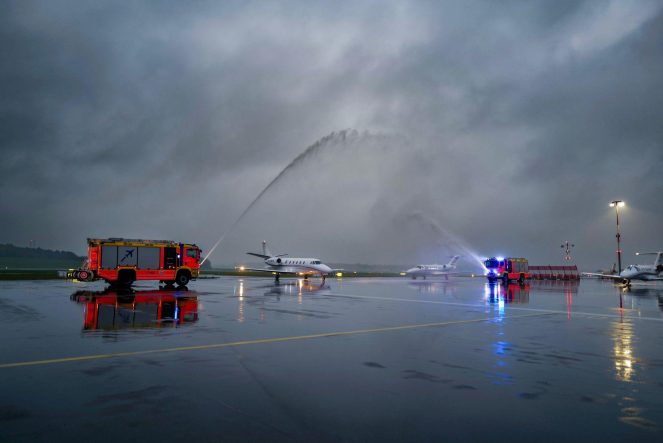
LUMINAIR’s first Cessna Citation XLS being welcomed to Hamburg Airport.
Five-year outlook
With Part 129 approval on the way from the FAA, delayed only by the regulator’s understandable backlogs, the US is the next market LUMINAIR has its eyes on. The firm was operating in and out of the US on a temporary approval throughout autumn and early winter 2025 using its Falcon 900s. Trotter said once approvals are issued it will be back stateside with the 900s and the Falcon 7Xs.
Looking at the fleet holistically, Trotter would “love” LUMINAIR to put a 1,000 flight hours per year on each airframe. “That way the owners are really happy, they’re getting an amazing return on investment on their aircraft,” he said. Operating its high-utilisation model, Trotter would also like to get under the 25% mark for ferry sectors.
“There’s an inherent net profit that comes with that and that is what we’re shooting for,” he explained. “We want to be net buoyant on capital in terms of our creditors. I think that’s an extremely realistic goal.
“Finally, I want LUMINAIR to be seen as a strong, stable, net-profitable company, that does not take advantage of their clientele. The clients get a good deal, the owners get a good deal and the business gets a good a deal. That is a cycle that is really important to me,” he concluded.
It was chatter over the radio waves that signalled the beginning of LUMINAIR’s journey back in early November 2024. Tune in for chatter of a different kind in the coming weeks as Trotter joins us for an episode of The CJI Podcast (the 21st century’s answer to the good old radio).