
Luminair welcomes first 7X to fleet
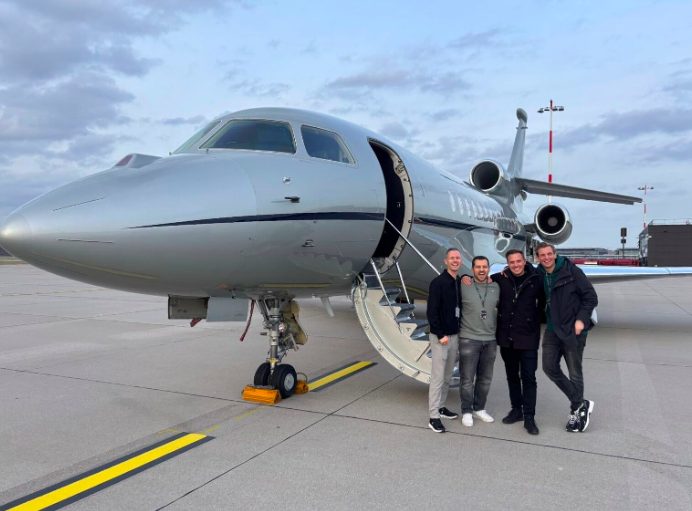
The aircraft, D-ALIN, which is ready for charter, offers long-range capability of up to 5,950nm.
LUMINAIR has taken delivery of the first of four Dassault Falcon 7X aircraft, the rest will arrive over the next quarter as the operator continues to expand its fleet.
LUMINAIR CEO and co-founder Algernon Trotter said the 7Xs were always part of the firm’s growth plan.
“We have significant experience with the type and consider it an excellent platform for ultra-long-range missions while maintaining very reasonable operating costs,” he explained. “It integrates well with our existing fleet and allows us to further expand our intercontinental capabilities.”
The aircraft has been delivered from within LUMINAIR’s wider investor portfolio. The company, which attained its air operator certificate (AOC) in late 2024, was founded by a group of former Air Hamburg and Vista employees. The Falcon 7X’s are being transferred from Vista’s German AOC and are set to arrive on a monthly basis following this first delivery, the company confirmed to CJI.
LUMINAIR operates a fleet of eight aircraft, but the number is regularly growing. Combined with announced deliveries, the fleet is set to grow to 14 by year end – six Cessna Citation XLS, four Dassault Falcon 900LX and four Falcon 7X.
Trotter hinted that the fleet could grow even further as the company set its sights on the super-midsize segment. An announcement on that order is due shortly, he added.
Following the introduction of the Falcon 900LXs, the 7X represents a “natural next step” in Luminair’s large-cabin growth strategy, said Trotter.
The Falcon 7X’s three engine layout provides competitive operating costs compared with other ultra-long-range aircraft, while good short-field performance allows access to airports that can be challenging for aircraft in its class, he explained.
Operationally, the aircraft will enhance LUMINAIR’s ability to serve its core markets of Europe, North America and the Middle East.
“The Falcon 900s are optimised for the Middle East,” said Trotter. “Compared with smaller aircraft like the Falcon 2000 or Challenger 650, when rerouting south over Saudi Arabia to avoid Iranian or Iraqi airspace, the 900LX with its 9.5-hour range can penetrate deep into Europe.”
LUMINAIR is in the double digits for repatriation flights out of the Middle East following the outbreak of regional conflict. Trotter said when the first strikes hit the United Arab Emirates, LUMINAIR had two 900LXs on the ground at Dubai International Airport and Dubai World Central.
“One had its engines running; we had to shut down when they closed the airspace,” said Trotter. “It was a nerve-wracking three or four days with six crew members and two aircraft stuck. We worked closely with the teams in Dubai, and the moment the airspace opened slightly, in the middle of the night, we got both aircraft out.”
Trotter pointed to the inherent flexibility of operating as a small business as to why LUMINAIR was able to act quickly to reposition its aircraft and coordinate repatriation flights.
“We have a structured approach, working closely with security teams, our insurer and crews. Being a small business lets us be super flexible. We do a night stop on Egypt’s Red Sea coast, then a quick mission into the Middle East to pick people up and fly to Europe, all within one crew duty,” he said.
“We are completely forbidden from doing night stops in the region – both for insurance and security reasons,” added Trotter.