
CAE adds immersive tool to air traffic services training
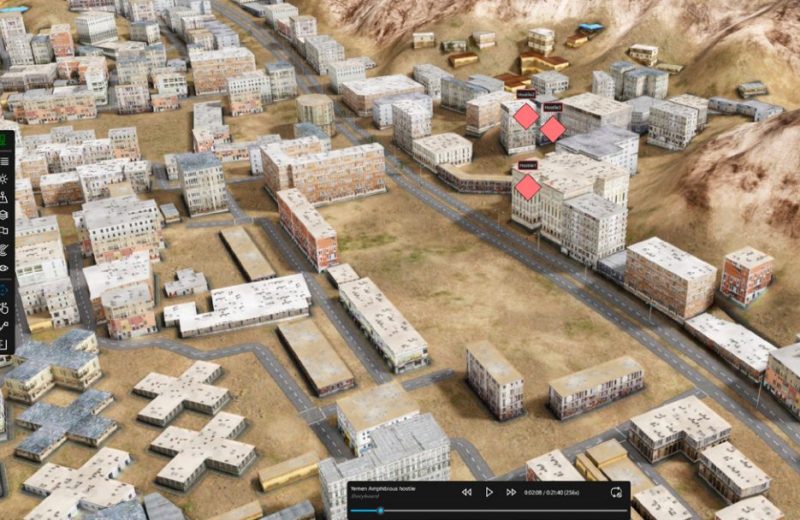
CAE is expanding the use of CAE Ridge, its immersive 3D visualisation tool, to its air traffic services training offering.
This commercial off-the-shelf solution, already in use in military applications by CAE Defense & Security, is now being used to enhance both civil and defence Air Traffic Services training. CAE announced the expansion at Airspace Asia Pacific 2025 in Hong Kong earlier this month.
In a nutshell, CAE Ridge is a 3D visualisation tool, according to Marie-Christine Cloutier, vice president, Strategy, Business Performance & Marketing, CAE.
“It leverages technology we originally developed for defence and security and applies it to air traffic services,” Cloutier told CJI. “Entering this new segment is about bringing that technology, know-how and resourcing into air traffic controller training.”
‘An immersive tool’
As global air travel continues to increase and airspace complexity grows, air traffic controllers face increasing demands. Before advancing to high-fidelity simulators and on-the-job training, they must develop strong mental models of airports, airspace structures and traffic flows. This is where CAE Ridge comes into play, said Cloutier.
“CAE Ridge is an immersive tool, which is what differentiates it from what’s currently on the market,” she explained. “It supports decision-making and training by allowing students to visualise traffic, aircraft movements and the multiple stakeholders involved in every decision an air traffic controller makes.”
At present, there are tools focused on movement software, but nothing that is fully immersive and 3D, said Cloutier. “That’s what CAE Ridge offers. It provides valuable support by enabling early assessment of student potential, which is a critical step in overcoming one of the biggest challenges in training. It is designed to bring out the best in students and helps identify those with the right mindset and capabilities early on and set them up for success.”
Emmanuel Levitte, chief technology officer, CAE, echoed this.
“CAE Ridge represents a meaningful advancement in preparing tomorrow’s air traffic controllers,” he said. “By introducing immersive 3D visualisation early in the training process, we help build confidence, competencies and situational awareness faster, increasing the effectiveness of training programmes.”
Identifying the problem
Globally, air traffic services face several challenges, according to Cloutier. First, there is a shortage of personnel. In CAE’s latest aviation talent forecast, published in June, it estimated that by 2034 the industry will need over 70,000 air traffic controllers worldwide.
Secondly, training duration is a challenge. In some countries, training takes around four years, which makes it difficult for air navigation service providers (ANSPs) to scale quickly.
Thirdly, the ways of learning haven’t modernised significantly. The tools, courseware and curricula have largely remained unchanged.
“This affects engagement and contributes to lower success rates compared with pilot training. As a training organisation, we believe modern learning tools can have a real impact here,” says Cloutier.
3D visualisation key to early learning
While advanced training tools for three-dimensional visualisation and mission simulation are regular aspects of pilot and mission crew training, similar solutions for air traffic controllers have been limited, according to CAE.
CAE Ridge turns traditional tabletop or more limited computer display training into interactive 3D environments that help instructors and new trainees.
“The key difference is scenario-based learning,” said Cloutier. “There’s also a broader challenge around awareness: many people don’t realise air traffic control is a career option, or how to pursue it. Recruitment is therefore difficult, and selecting the right profiles is critical.”
Reducing training time, improving success rates and modernising learning methodologies are the key areas where CAE Ridge can have a real impact. “Across our existing contracts, we’ve already seen training time accelerate through technology use, and we hope to achieve similar results with CAE Ridge,” said Cloutier.
CAE Ridge also helps to identify individuals who are strong at scenario-based thinking, multitasking and decision-making, added Cloutier. “Using mixed reality, both the student and instructor wear headsets and can discuss live scenarios together. This immersion accelerates onboarding and allows instructors to assess potential very early,” she explains.
Where else can CAE Ridge prove helpful?
Beyond foundational training, CAE Ridge supports pre-simulator preparation, debriefs, procedure rehearsals, initial learning for transferring qualified controllers, Competency-Based Training and Assessment (CBTA) scenario development and operational reviews.
There is also a strong parallel with pilot training, according to Cloutier. “The aim is to reduce time away from operational environments. Given the global shortage of controllers, we want them in towers, not travelling for training,” she said.
“Mixed reality tools could reduce travel, downtime and disruption, subject to regulatory approval,” added Cloutier. “The goal isn’t to rush training, but to make it leaner, more efficient and more effective.”
Next steps
The company recently showcased CAE Ridge at Airspace Asia Pacific 2025 and saw “strong interest”, particularly from ANSPs in the Asia-Pacific region.
The next step is partnering with an ANSP to embed CAE Ridge into its existing curriculum and tools. “Unlike pilot training, which tends to be sequential, ATC training is highly iterative — classroom learning alternates constantly with simulator sessions. That makes CAE Ridge easier to integrate,” explained Cloutier.
“We also adapt to regulatory requirements. Currently, we’re aligned with Transport Canada through NAV Canada, and soon with EASA requirements through our planned partnership with the Czech ANSP,” she added.