
Klatt Works expands augmented reality smoke displays to bizav market
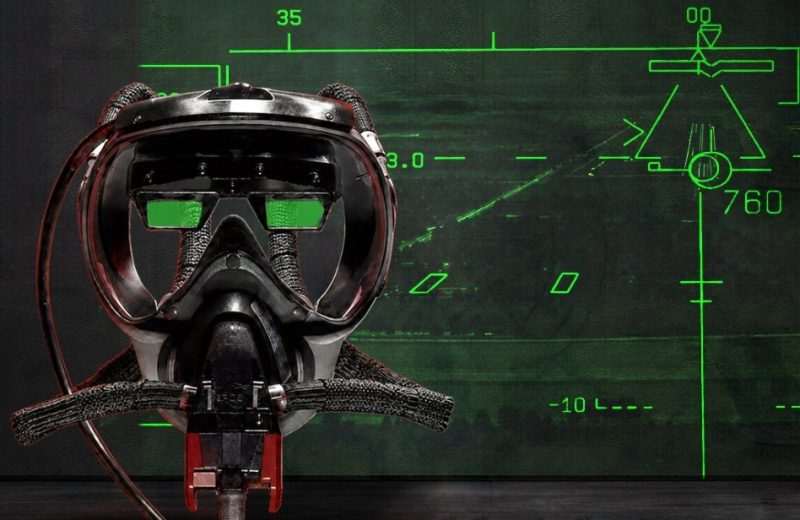
Klatt Works, an augmented reality company, founded by Nate Klatt, is pushing into the business jet market with its display system designed to let the pilots keep flying and land safely should the cockpit fill up with smoke.
The California-based company’s product is called SAVED (Smoke Assured Vision Enhanced Display). The product fits inside a full oxygen mask and projects a video feed from the aircraft’s nose camera. This is overlaid with heads-up display (HUD) flight data.
“What we’re doing is enabling the pilots to see the video out of the front of the aircraft with all the airspeed, altitude, heading and all of the essential information to fly the aircraft, even if they can’t see their hands in front of their face,” Nate Klatt, chief executive of Klatt Works tell us. “This gives the pilots a fighting chance of getting the aircraft safely on the ground during a potentially catastrophic situation.”
The company did not set out to build cockpit safety equipment. The team originally developed augmented-reality glasses for other applications before teaming with the cargo giant FedEx on the specific problem of smoke in the cockpit.
“We were essentially a startup that really focused on solving a problem initially for FedEx,” Klatt said. “They found us at one point and said, that’s really cool, can you put that inside of an oxygen mask? And we went, why would you want to? And they said, well, it turns out smoke in the cockpit is a thing.”
SAVED integrates with Zodiac’s MF-20 and MLD-20/40 masks, already equipped on many aircraft. Moreover, it also fits within the existing stowage box, so it does not require new storage space in the cockpit.
The displays are see-through when switched off. “If you don’t have smoke in the cockpit, or let’s just say you’re smelling it and you don the oxygen mask right away, the pilot might still be able to see fine for some time, so at that point they should continue to fly the aircraft normally,” Klatt said. The optical core is only used when the visibility is actually lost.
Klatt says they are now actively pursuing new certifications in the business jet market, while other certifications like the 757 are being developed with FedEx. He warns that the business jet world frequently underestimates the odds of a smoke, fire or fumes event in the cockpit. Based on incident data, Nate estimates a pilot’s odds of encountering such an event over a career are roughly 70%. This is higher than a US driver’s lifetime odds of an airbag deployment or a 30-year risk of a hurricane, earthquake or tornado damaging a home in high-risk areas.
On fires in the cockpit, Klatt says there isn’t one single dominant cause. He cites figures attributing roughly 37% of fire events to electrical system failures and about 26% to engine oil or hydraulic fluid leaks contaminating bleed air, with lithium-ion battery incidents making up roughly 8-10%.
“There isn’t like one smoking gun,” Klatt said. “It’s more about not trying to pretend like you can prevent smoke in a cockpit, although we should identify and mitigate causes. It’s how do you deal with it when it happens.”
SAVED requires an aircraft already equipped with a HUD computer and EVS. Klatt said the system holds an FAA supplemental type certificate (STC) for the Gulfstream G550, Boeing 767 and Boeing 777 aircraft. A flight test on the Gulfstream G650 is scheduled within the next month, and the company said it plans on integrations with Bombardier aircraft.
Within business aircraft, Klatt says the HUD-equipped Gulfstream aircraft from the G450 and G550 upwards, Bombardier’s Global fleet, Dassault Falcon jets, Embraer Preator and the newer Cessna Citation Longitude as the earlier addressable business jet market for SAVED. Additionally, the company will need to certify the system outside of United States with authorities like EASA, UK CAA and Transport Canada.
Each installed aircraft receives two masks, one for each pilot seat, which Klatt says will preserve crew coordination during an emergency. HUDs are often installed only on the captain’s side. “The co-pilot can call out altitude or airspeed issues as they arrive while they’re also working the emergency procedures,” he said.
Klatt says they manufacture the hardware in-house with “hundreds” of displays already delivered in the commercial airline market before beginning to expand into the business aircraft market. The company plans to carry out installations and customer relationships through a network of resellers which currently includes Gulfstream, Duncan Aviation, West Star and Altus Aerospace.
Because those service centres already schedule customers’ maintenance visits, Klatt says SAVED can be installed during work the aircraft is booked in for anyway, minimising or even preventing additional downtime.
The company said it has SAVED installed with pilot training centres to run full-motion simulator demonstrations for prospective customers on the G550 and G650.
In one recent case, Klatt said, a Falcon jet pilot with no prior time on a Gulfstream aircraft or simulator was given minutes of basic orientation before donning the mask, with the oxygen mask visor totally blacked out to simulate zero visibility.
“He landed it two for two times without any previous training or background in the aircraft,” Klatt said. “It’s very intuitive, because it’s the exact same image they’ve already been trained on.”
Subscribe to our free newsletter
For more opinions from Corporate Jet Investor, subscribe to our One Minute Week newsletter.