
New Otto Aerospace CEO confirms ‘good progress’ on Phantom 3500 certification
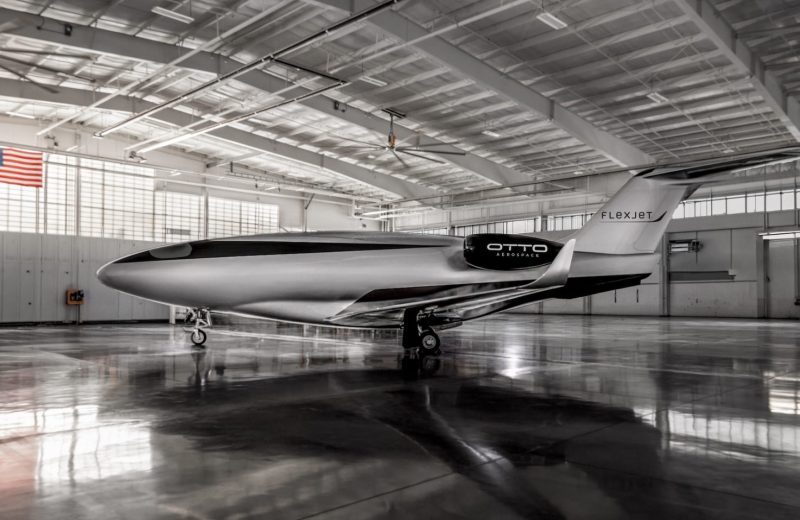
Otto Aerospace announced a firm order from Flexjet for 300 aircraft in September 2025.
A little over a month into his new role as CEO of Otto Aerospace, Scott Drennan says the Phantom 3500 aircraft programme is “on track”.
Updates from the programme are arriving thick and fast as Otto Aerospace moves into what Drennan describes as the “execution” phase. The company passed a preliminary design review (PDR) which sets the stage for hardware fabrication and assembly as it prepares for a first flight of Flight Test Vehicle 1 in 2027. Otto has also selected Austrian interiors specialist F/LIST to design the cabin.
Meanwhile, the company is integrating data from a successful flight test campaign with an uncrewed drone designed around its laminar flow technology in partnership with the US Defense Advanced Research Projects Agency (DARPA). To date, the campaign saw the drone amass around three hours’ flight time across five sorties in New Mexico at the White Sands Missile Range.
Drone test flight learnings
The project underlines the potential for carry-over innovation development. Otto had originally began building a drone as a truck to hold a laser reception and transmission system that theoretically could receive laser energy, charge the batteries onboard the aircraft and then transmit that energy to charge other vehicles or be used in a directed energy application.
DARPA shared Otto’s design review for the drone with other military branches, which came back with a unanimous: ‘Maybe we don’t have to wait so long for the laser – you have a really long-range drone here, don’t you?’.
“We said yes, that’s what laminar flow does. They asked us to look at what it would look like if we put an internal combustion engine on board,” Drennan told CJI. The result is a full-scale synthesised design weighing about 3,000 pounds with a 3,500nm combat radius.
The drone that flew in New Mexico was a scaled version with a 20ft wingspan and a Reynolds Number in 6-8m range.
“Here’s our magic: we built a drone at a certain size and flew it at a certain altitude to match the coefficient of lift and the Reynolds number of the larger drone up at 60,000ft,” explained Drennan. “We’re getting great validation of our CFD tools – which are proprietary to us and are the key to determining if you can get laminar flow – and also our scaling methodology, to help our stakeholders invest appropriately in the beginning with a smaller scale drone or a wind tunnel test.”
Drennan’s mantra since joining Otto, initially as chief operating officer in late 2022, has been: “you’ve got to design in laminar flow, build in laminar flow, and keep in laminar flow.” Historically, people could not predict laminar flow performance well enough, hence why it has been largely excluded as a potential innovation despite research dating back to the 1930s.
Otto’s CEO said the drone proves the company thesis on laminar flow in a different mission space – the dual-use drone market. “This is really encouraging because the question for everyone is always: Can we make pragmatic designs that incorporate it and serve a purpose for human beings, whether commercial or military or anything in between?
“You’ve got to build it in. Small, deterministic steps, gaps, waviness – that’s got to be on the 3500, it’s got to be on the drone. We physically built it on the drone. We used some of the same techniques that we’re going to use on the Phantom 3500,” said Drennan.
Importantly, from an economic perspective, development of the drone has proven it can be built for about $2m, continued Drennan. “People say in the attritable world of quadcopters that’s not very attritable,” he said. “But it is if you’re flying at 60,000ft for a 3,500nm combat radius. You can’t get up there to take it down without an exquisite weapon that costs ten times as much.”
What does this have to do with the Phantom 3500? According to Drennan, the attritability of the drone “all comes from our modular manufacturing process”. A process which is quite similar to that Otto Aerospace intends to adopt for Phantom 3500 production. “We can build all the drone pieces in the same press as the Phantom 3500 wing. So we’ve got some great synergy there and great validation,” he noted.
Phantom’s five-point plan
Drennan put together a blueprint to smooth the transition in both leadership and programme phase. The first point is moving from “vision” to “execution”. “We’ve got a great product definition set, a great business model set, and now we need to get to building it and flying it,” he said.
Points two and three are the aircraft and drone development programmes. With “supreme focus” on the Phantom 3500, Drennan said Otto is also looking for opportunities for the drone — whether that be through further defence initiatives or selling to customers in the defence and civil arenas.
The fourth piece is a roadmap outlining future technology, products and business strategies. “That roadmap is going to tell us about the next sized aircraft in the commercial space or in the private space, wherever it might be,” explained Drennan. “It’ll tell us about the technology that’s applicable there. Have we discovered things about laminar flow that we didn’t know before? And we could apply certain technologies to get more, or get the same amount for a larger aircraft that we didn’t think we could do before.”
Finally, the fifth point is to raise the Series C. “We’ve got to focus on that – raise the money – and get ourselves to a first flight in 2027,” he said. In the meantime, Otto Aerospace is “sustaining well” with its current capitalisation and has recently welcomed new investment following Drennan’s appointment. “That gives us a nice little bridge to continue to raise the rest of the series C through the summer and into the autumn,” he added.
What is changing under Drennan?
Although little is changing on the execution side, Otto has shuffled its team around following the departure of ex-CEO Paul Touw because the company opted not to hire a replacement for Drennan’s former chief operating officer role.
Kyle Heironimus, who had previously served as vice president of engineering, is now chief technology officer, bringing engineering, certification, testing and advanced concepts all under the technology officer.
Meagan Villanueva has been promoted to vice president of programmes, moving up from her former role as director of programmes. Villanueva will oversee commercial, military and contracted R&D grants.
Finally, Drennan has created an integrated operations (IO) leader role that reports to him. The IO leader handles handle manufacturing, supply chain, facilities, and quality. Having just joined last week, the company is not yet revealing who has taken up the job.
“If you go back to the five-point plan – how do we do it? When a product or technology is ready to be brought to the executive leadership team, we take a look, we ask questions. Is it right for the business? Is it right for the technology we have? If the answers cycle and become yes, Meagan makes it a programme of record. And we execute,” said Drennan.
“Megan is a supreme executor. She puts things in phases that we can sprint to, and it gives everyone something to focus on in a little bit of a shorter time period. When you accomplish it, you feel great about it. You understand what it leads to in the next phase.”
Execute, concurrently
The old notion of doing a design loop, freezing it, everyone looking at it, then making changes, doing another one and freezing it – that’s gone for Otto, said Drennan.
“We are living live inside the model all the time, so that one person touches a piece and another person sees it being touched,” he explained. “You just continually make updates day-to-day as you’re living in the model together.”
This approach saves a “ton” of time, added Drennan. Looking at the timeline, predicted milestones are approaching fast. The company was founded in 2008, but did not unveil the Phantom 3500 until June 2025. First flight is scheduled for 2027 and type certification is expected in 2030-2031.
“Using that technique is essential to what we’re doing,” said Drennan. “It also makes sense with the tool set and for the quality of the design, because you’re always living it and you do all those incremental changes that pile up to a revision number or a design review. This way you catch everything much better than piling them up in a list, letting some of them get stale and then trying to think about them in the turnover.”
Lessons from the past
Drennan spent more than 26 years at Bell Flight. Beginning as a structural analyst in 1993, he also headed up engineering on the twin-engine tiltrotor AW609 and finished up his time at Bell as vice president of Innovation and Advanced Concepts. He also has or continues to hold advisory roles at Hyundai (Supernal), Elroy Air, Near Earth Autonomy and Regent, sits on the board of directors at Electric Power Systems and founded his own company Drennan Innovation. This experience means Drennan has many lessons to draw on as Otto builds the Phantom 3500.
His first lesson from certification of complex systems is humility. “Aerospace and defence programmes are some of the most complex systems of systems problems that exist. No matter what – whether high-speed VTOL, V280, V22, my UAM stuff – that doesn’t mean I get to apply the easy button to something later,” he explained. “Certification and the complexity of aerospace systems humbles a person, and it should.”
The second lesson is partnership. Drennan is clear that everyone in the company needs to build a relationship with their regulatory counterpart – from CEO to a newly-hired engineer.
“There’s another person on the other side of the table that you’re asking to agree with you and find compliance with you,” he said. “They don’t do your job every day working on that laminar flow wing or laminar flow fuselage. So you need to bring each other to the same place with respect and dignity and the great joy of learning and teaching each other. That goes both ways when you’re working with the FAA – come to the table together.”
‘Good progress’ on certification
From a technology standpoint, for a man accustomed to the Bell standard of treating G-1 issue papers as “table stakes”, Drennan said he is proud that we have now received our approved G-1. (The G-1 establishes the minimum requirements necessary for a programme to reach type certification with the regulator). The means of compliance (G-2) is set to come out in about a month, he added.
“We’re excited to get those out. That was something I never talked about when I was at Bell because it’s really table stakes, but it became quite popular to note that your certification basis and your means of compliance were done,” he explained. “That was because we were dealing with new technology in AAM and trying to make sure people saw our progress.”
Phantom 3500 is being certified under 14 CFR Part 23. Not to be confused with 14 CFR 21.17(b), the regulatory framework powered-lift eVTOL aircraft, such as Joby Aviation’s S4, are certifying under. The 14 CFR Part 23 framework has been around for decades and has seen aircraft such as the Embraer Phenom 300, HondaJet and Cessna Citation CJ3 certify under it.
“The structure and framework of Part 23 is great,” said Drennan. “I knew about that before. We’re just fully embraced inside of it. We had our preliminary type certification board meeting with the FAA already, and there’s nothing new and novel on our aircraft according to them. For an innovation guy like me, that stings for about ten seconds, but that’s exactly what I’d like them to say.”
The best example of this is the laminar flow performance technology. This is what Otto Aerospace depends on as a business. But from a regulatory standpoint, it is viewed in the same way as normal turbulent flow flight, in others words it is not a distinct safety issue. “You have to have your control volumes correct, you have to have your gust capabilities thought about, and we do that and the FAA recognises it and we move on well together,” said Drennan.
The Phantom 3500 aerodynamic design and major interfaces are now frozen at the PDR, but that does not mean the engineering team is not remaining hawk-eyed on risks ahead of its critical design review – which is approaching fast.
Weight is always the number one risk item, but that goes for any aircraft programme. High on the list at Otto Aerospace is icing because of the impact ice build up on the wing’s leading edge can have on laminar flow performance.
“We thought we needed an electric heater blanket and the piezoelectric thumper system, but actually we only need the piezoelectric thumper system. That requires a lot less power and still meets the requirements of flight in known icing,” said Drennan.
The company is compiling intellectual property around its leading edge, that is where the icing system is integrated. It also performed some icing tunnel testing earlier this year at LeClerc Icing Research Laboratory run by Cox & Co in Plainview, New York.
“We have a separate wing leading edge section and we’ve got a proprietary interface of how we connect that assembly to the main wing box that maintains the laminar flow and allows us to maintain the actual part and the system contained within it,” said Drennan. “The Cox system that we’re using is highly reliable and they have some good field data on it.”