
Hop-A-Jet: ‘We will do all we can to ensure this never happens again’
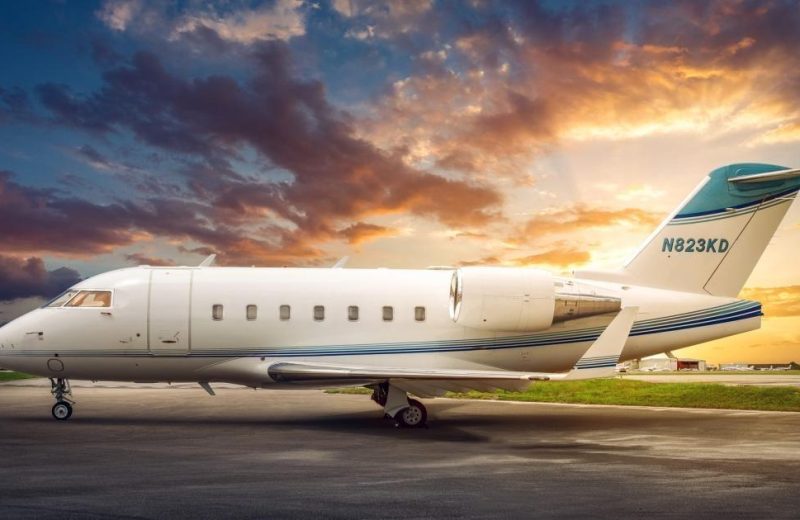
The Bombardier Challenger 604 (reg: N823KD) suffered loss loss of power to both engines on approach to Naples airport, Florida on February 9th, 2024.
On April 23rd, the US National Transportation Safety Board (NTSB) published the final report on the crash of a Hop-A-Jet Bombardier Challenger 604 on February 9th, 2024. It cited corrosion in the aircraft’s General Electric (GE) CF34-3B engines’ variable geometry (VG) system.
Both of the Challenger’s engines lost power on approach to Naples Municipal Airport (KAPF), forcing the aircraft to land on the nearby Interstate 75 claiming the lives of both pilots. Two passengers and one flight attendant were able to escape via the baggage door at the rear of the aircraft.
The final report brings official closure to the accident, but according to Barry Ellis, president and director of operations at Florida-based Hop-A-Jet, the story is far from over. In ensuring a similar accident never happens again, Hop-A-Jet is taking multiple steps including building its own test tool to identify corrosion, calling on the FAA to mandate baseline boroscopes and more frequent pressure tests and issuing a post-final report public submission.
Reacting to the final report, Ellis told CJI: “I definitely think that the general public will be able to understand it because of the way that it was written – the mechanical issues.

Barry Ellis has been with Hop-A-Jet since early 1990.
“There was certainly relief at having the final report issued, however we’re never going to get our friends and crew members back. Ed Murphy, the captain, had been with us for 30 years – he started his aviation career here. The first officer Ian Hoffmann had come back to us within the last year or two. He started his career in the ’80s at Hop A Jet, then went off and did a 30-year airline career and came back to us when retiring.”
The NTSB report notes that the Challenger 604 experienced a hung start 25 days before the accident and the MP68 pressure test – a gauge that measures the pressure of the air-fuel mixture in the intake manifold – was not run because the engine started normally afterwards. Looking back, Ellis said he would make changes to Hop-A-Jet’s own troubleshooting checklist, even if the manufacturer’s flow chart deems the engine airworthy.
“I don’t want this to sound coarse, but I think our trust in manufacturers or in the experts is somewhat jaded now,” said Ellis. “I think we’ll likely not go solely by instructions of manufacturers. The MP68 was a long ways down the troubleshooting checklist, and whereas a number of the reports make it seem like the airplane started and we just continued operating, that’s very far from the truth.”
Cancelling a scheduled trip due to take place that afternoon, Hop-A-Jet grounded the aircraft and contacted the engine manufacturer to assist it with troubleshooting.
“We did a number of airframe-related checks to make sure that sufficient pneumatic pressure was there,” he continued. “Once we ruled out the airframe, we began down the engine manufacturer’s checklist with their concurrence. The airplane was on the ground for three-plus days, ran hundreds of gallons of fuel through it in the run-up area, trying to get it to break.
“Many, many, many man-hours.”
Ultimately, Hop-A-Jet changed fuel filters, completed each early step of the troubleshooting checklist and could never get it to fail again.
“Of course, hindsight being 20-20, but knowing what we know now, we certainly would have skipped ahead and done that check,” said Ellis. “That being said, we can’t bring back or erase what’s happened, but we can try to do everything in our power to have it not happen again.
“Throughout the NTSB process, we’ve looked at it that way. We’ve petitioned for service bulletins and debated with the engine manufacturer over the emphasis on certain parts of and the severity categorisation of the service bulletins,” he added.
The biggest immediate change following the report’s publication is that MP68 is now at the top of every checklist. After checking whether there is sufficient pneumatic pressure to spin the starters, if a hung start occurs, MP68 is the next test on the list. “Hopefully, people adhere to that,” said Ellis.
This change is the subject of an airworthiness directive (AD) currently out for public consultation. “The directive will call for a boroscope and MP68 to be done to most engines, not just the ones that have had hung starts,” said Ellis. “That goes further than the three service bulletins put out by the engine manufacturer since. Our hope is that the AD will be written so that it’s not confusing and that it mandates these checks because we feel like the sampling hasn’t been sufficient to really show the true problem to date.”
The NTSB issued no formal recommendations in its final report. Ellis believes this is because there have already been multiple steps taken by the engine manufacturer to ensure such an accident never happens again.
Despite this Hop-A-Jet is planning to issue a post-final report public submission which will include further recommendations Ellis would like the NTSB, FAA, engine manufacturer and wider industry to consider. He believes there were other opportunities, even prior to the hung start incident, for the corrosion issue to be caught.
“Being on condition, every 3,200 hours, there is a big inspection on the engine, mostly consisting of the boroscope,” Ellis explained. “This airplane had that inspection at a 3,200 hour interval that it had reached six months before the accident, in September 2023.”
The inspection was carried out on site at Hop-A-Jet’s facilities by GE and the engine was given a clean bill of health.
“That was a very big missed opportunity, in our opinion. Taking a look at the criteria that gets reported from the 3,200 hour boroscope inspections, if the engines are to stay on condition, that inspection, we feel, needs to be much more robust. Corrosion needs to be high on the priority list.”
Following the accident Hop-A-Jet grounded the rest of its Challenger fleet to check for corrosion and found similar issues on each aircraft.
“We have a Challenger 605 that did not have a hung start history. The manufacturer did MP-68 and found that the amount of air pressure used to simulate the fuel pressure that normally moves the VG system in flight took too much air pressure to move it.”
Watching the motion of the VG systems, Ellis said movement was not fluid, “they were jerky”. GE ultimately decided that both of those engines needed to come off and go for repair, he added.
Hop-A-Jet also had a Challenger 650, which was only about a seven-year-old aircraft at the time of grounding. “That airplane had experienced hung starts throughout its life. They took both engines off that airplane too. That was a low-time aircraft,” he noted.
Ellis believes this corrosion problem doesn’t necessarily discriminate against aircraft just due to age. “I think the environment that they live in does have a significant part in it, but you would expect the inspection criteria and the inspection processes to be sufficient to catch something like this before it reached such a critical level,” he said.
If an operator calls Hop-A-Jet today and says ‘we just had a hung start on a CF34-3B, what should we do differently from the manual?’, Ellis said: “Stop flying the aircraft immediately, call the engine manufacturer, and point out that you have a hung start and suspect a variable guide plane corrosion issue.”
As a pilot himself, Ellis estimates that following a hung start most pilots would stop the start process, try to start it again, and if it starts normally, “go right on with life”.
“You’ve got the pressure of you’ve got the boss or you’ve got the passenger sitting in the back, you’re on a ramp, you’ve got your clearance, you’re ready to taxi, they’re going to try it again, and I would highly recommend against that with what we’ve learned now,” he explained.
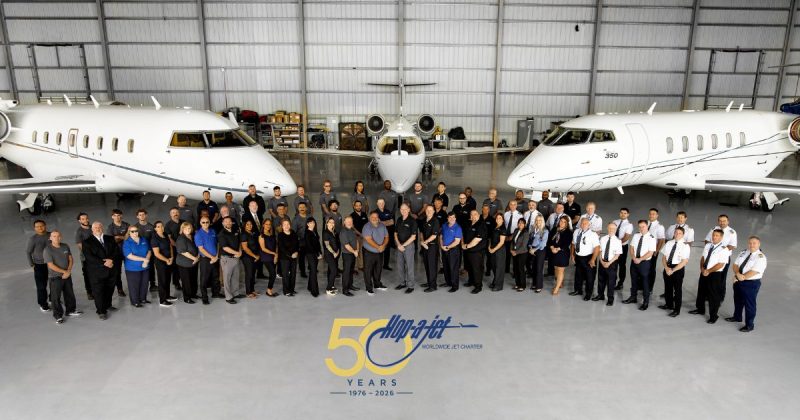
To celebrate its 50th anniversary, Hop-A-Jet hosted an event at its facilities on Saturday, April 25th.
Hop-A-Jet is marking its 50th anniversary this year and Ellis is clear the company is proud of its legacy. “It is an extended family, we have alumni that flew with Harvey Hop 40 years ago,” he said. “After an accident some companies consider rebranding, but there aren’t many companies that have a legacy like this company has, so we wanted to try to do everything we can to continue on as Hop-A-Jet.”