
Academy Aviation Group to invest in VR training as it targets mixed-fleet operators
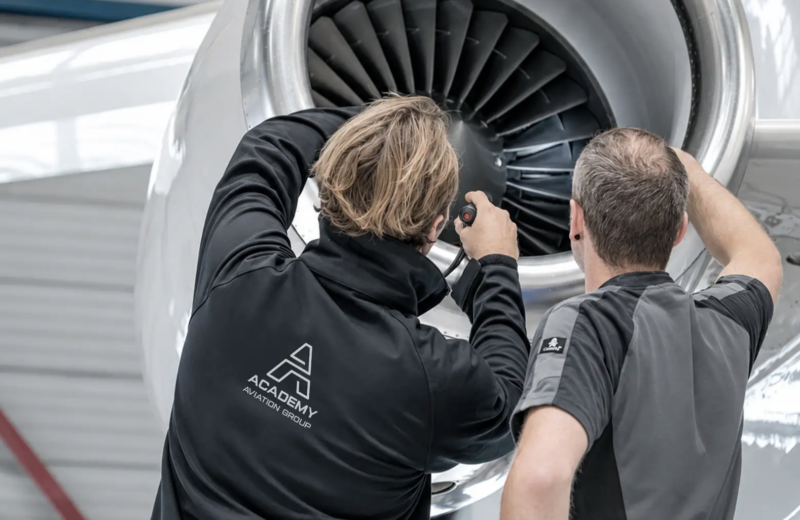
The group, which offers maintenance and technical training for business aviation, is made up of three companies.
Academy Aviation Group is exploring virtual and augmented reality training and adding courses for newer business jets as it positions itself as a training provider for operators working across several regulatory regimes.
The group, which offers maintenance and technical training for business aviation is made up of three companies: Academy 147 in Malta, Academy Aviation Maintenance Training in Florida and Academy Aviation Online.
Academy 147 holds approvals and acceptances from six aviation authorities: EASA, the UK CAA, the UAE’s General Civil Aviation Authority, the Civil Aviation Authority of Singapore, India’s Directorate General of Civil Aviation and Australia’s Civil Aviation Safety Authority. It also delivers FAA-compliant courses through Academy Aviation Maintenance Training.
“For business aviation operators, aircraft and maintenance personnel frequently move between jurisdictions, each with its own regulatory requirements,” said Yuliia Podzolkova, commercial and business development manager at Academy 147. “This means MROs and operators can work with a single established training organisation for a wide range of regulatory requirements rather than having to source different providers for every jurisdiction.”
Podzolkova said the approvals required ongoing work. “These approvals are not simply certificates obtained once — maintaining them requires continuous oversight, compliance with applicable standards and regular engagement with the relevant authorities.”
Academy 147 covers more than 40 business jet type ratings, from Gulfstream’s G150, G200 and G280 to G700 and G800, as well as Bombardier Challenger and Global aircraft, the Dassault Falcon 900 and 2000 families, Cessna Citations, the Embraer Phenom 300 and the Learjet 60.
“For MROs and operators working with mixed fleets, this breadth is particularly important,” said Podzolkova. “Instead of dealing with multiple training organisations for different manufacturers or aircraft models, they can consolidate much of their training through one group.”
She said the biggest benefit for customers was “various delivery formats combined with consistent training quality”, adding that training costs go well beyond course fees to include travel, accommodation, staff availability and aircraft downtime.
Academy Aviation Online offers more than 100 self-paced courses covering subjects including human factors, fuel tank safety, electrical wiring interconnections systems and aviation regulations. It recently launched an upgraded platform with improved course access and automated enrolment.
“We see digital learning as a complement to instructor-led and practical training, rather than a replacement for it,” said Podzolkova. “Aircraft type training often requires more structured instruction, direct communication with experienced instructors and, where applicable, practical training on actual aircraft.”
AAG is now exploring animated technical content, 360-degree virtual aircraft walk-arounds and virtual and augmented reality applications. It also plans to expand its practical training network through partnerships with MROs and aircraft operators, and to pursue further regulatory recognition where customers need it, said Podzolkova.
“These technologies have the potential to help students visualise complex aircraft systems and make technical education more engaging and accessible,” she continued. “As aircraft become increasingly sophisticated, maintenance training must continue to evolve alongside them.”