
OEMs’ results race ahead
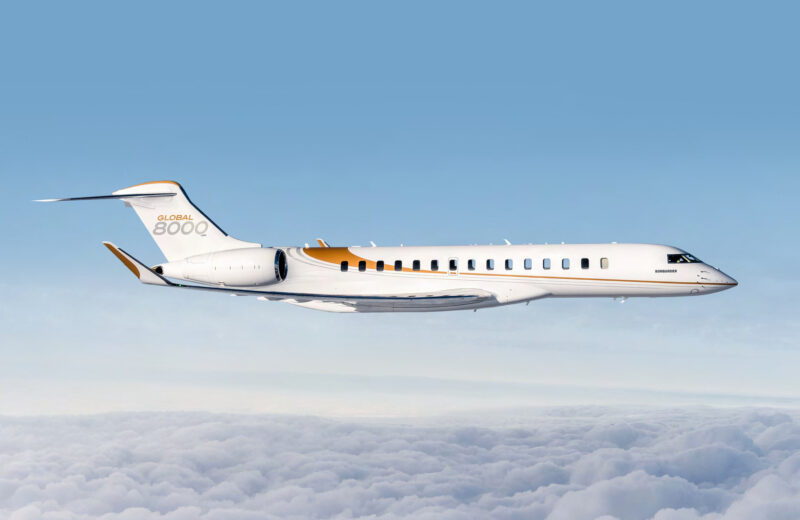
The Global 8000 that set a record this month carries up to 17, flies 8,000nm.
In the summer of 1969, a Grumman Gulfstream II flew executives from Teterboro Airport in New York to Paris for the 28th Paris Air Show, in under eight hours and 32 minutes. The flight set a transatlantic record. It also re-enforced the reputation of executive jets as an essential business tool.
Fifty-seven years later, a Bombardier Global 8000 flew from Los Angeles (LA) to the Farnborough Airshow in the UK in a record eight hours and 46 minutes. Bombardier promptly revealed a letter of intent (LOI) specifying firm orders for two Global 8000s, five Challenger 3500s and five Global 5500s plus purchase options on 48 more aircraft. The buyer was The Helicopter Company, a subsidiary of Saudi Arabia’s Public Investment Fund (PIF).
Business aviation has come a long way since 1969. Manufacturers’ recent second-quarter results measure the pace of that progress and hint at new records ahead.
Gulfstream – which just happened to reclaim the LA to Farnborough speed record with its G700 this week, “shattering the most recent record by 19 minutes” – posted what CEO Phebe Novakovic called “a special quarter”.
Revenue of the General Dynamics’ Aerospace segment rose 15% to $3.5bn. Operating margins jumped 130 basis points to 14.5%. The 100th G700 was also delivered during the quarter. Total aircraft deliveries reached 41, up three from the same quarter of 2025. New orders of $5.3bn were booked during the quarter. This was the strongest first half in terms of orders for the company since 2022. Overall, Gulfstream backlog has reached $24bn, up 20% year-on-year.
“We see very active interest across all models in the US and Asia,” Novakovic told analysts. She highlighted that Middle Eastern customers have stayed active despite conflict in the region. Danny Deep, president of Gulfstream’s parent company General Dynamics confirmed the G700 and G800 still have room to expand margins. The supply chain, a persistent problem for much of the industry, is largely under control, claimed Deep. “Gulfstream has a very clear relationship that has really given the supply chain visibility,” he added.
Bombardier revealed its Q2 results shortly after announcing its new speed record at the Farnborough Airshow. Revenue rose 6% to $2.15bn. But the headline numbers were underneath in the income statement. Adjusted net income more than doubled to $257m. Free cash flow swung $392m to a positive $228m. The backlog jumped 25% to $21.8bn.
It also shrunk its net debt to EBITDA to 1.6x, closing in on its long-term target of 1.5x. Deliveries were four units less at 32 compared with last year’s tally. Bombardier’s delivery calendar has always been weighted to the second half.
On the other side of the Atlantic, French OEM Dassault Aviation’s Falcon business had an excellent first half. Falcon sales amounted to €1.2bn ($1.37bn), compared with €1.1bn last year.
Thirteen Falcons were delivered during the first half (one more than last year) with 27 remaining for second-half delivery. Falcon orders reached €1.9bn while Dassault’s backlog climbed to €5.4bn. The Falcon 10X flew for the first time in June. Dassault is the only manufacturer to have flown an entirely new aircraft of this size in 2026. Its entry into service is scheduled for 2029.
Textron Aviation had a more challenging quarter. Revenue was flat at $1.5bn. Jet deliveries fell to 40 from 49. CEO Lisa Atherton blamed delays in the arrival of critical components and lingering workforce issues. Chief financial officer David Rosenberg said the two challenges took away $150m from the bottom line. However, the $8bn backlog and simultaneous flight testing of all three Gen3 Citation light jets provides grounds for confidence. Atherton expects the productivity picture to improve significantly by mid-2027. “We have very strong demand,” she said.
The Gulfstream II that crossed the Atlantic in 1969 carried eight passengers and had a range of 3,600nm. The Global 8000 that set a record this month carries up to 17, flies 8,000nm and does it at Mach 0.85. And the G700 that reclaimed the record for Gulfstream carries up to 19 and can fly up to 7,750nm at Mach 0.85 or 6,650nm at Mach 0.90.
Technical progress is racing ahead. The overall financial performance of most business jet manufacturers doesn’t seem far behind.
Subscribe to our free newsletter
For more opinions from Corporate Jet Investor, subscribe to our One Minute Week newsletter.