
SkyAccess CEO on realising the empty leg opportunity
SkyAccess has made it free for operators and customers to use its platform, it then charges an “Airbnb-like” service fee on each booking.
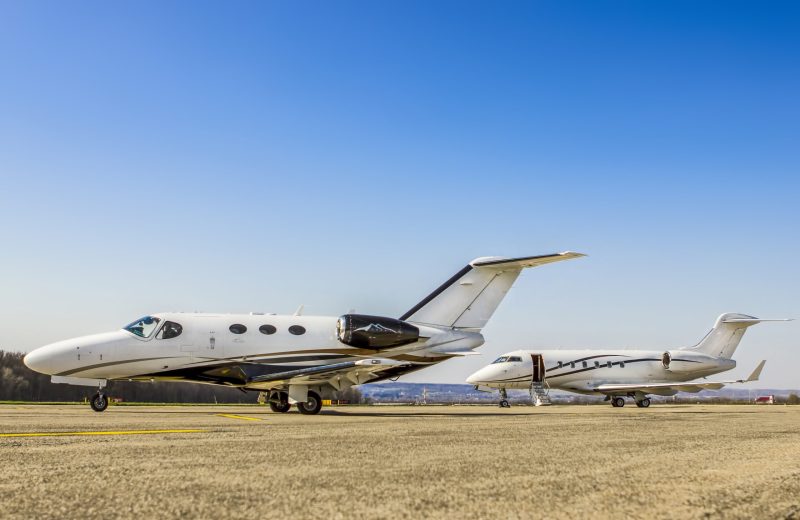
Roughly four of every 10 private aircraft flights fly empty, stacking up to over one million passenger-less movements every year.
Hearing this figure time and again from the pilots they surveyed catalysed the founding team to launch SkyAccess, an online marketplace platform designed to provide unprecedented access to empty legs. After 17 months in business, the company has more than 400 active operators on the platform and about 230,000 active users.
“We realised that somebody told people that this world is not for them, that they cannot afford it,” Daniil Buriev, CEO and co-founder of SkyAccess told us. “But over a million flights operate empty without passengers each year. We think it was never about affordability; it was really about access, because it was usually hidden behind broker networks.”
Different from the failures?
The graveyard of failed empty leg booking marketplaces has numerous headstones. Platforms for booking positioning flights have often failed largely due to high cancellation rates and stale inventory. Past failures were considered when launching SkyAccess, said Buriev.

Buriev has served as SkyAccess CEO since January 2025.
“I know there have been attempts where they would show you empty-leg availability given your routing, but they would never actually calculate the time impact, how much of it is billable duration, how much it should be billed at, or what the actual total should be. SkyAccess does it in real time,” he said.
The team has developed a reliability scoring system which tracks and defines the quality of every listing. “That means out of the flights you see on SkyAccess, how many of them can you actually book and everything goes as planned – booked at the price you see, on schedule, available – is graded out of 100. All our efforts are currently targeted to increasing that reliability score,” he said.
Today, there are about 600 active flights on SkyAccess that are eligible for instant booking, a new feature it rolled out last month. Based on at least 500-plus bookings for the operator, if the reliability score is above 95 out of 100, they are enabled for instant book. “Meaning you can go and secure it right away with either credit cards or crypto,” he said.
On cancellations, Buriev believes there is a public “misconception” that empty legs are regularly cancelled. “But it’s operator-specific,” he said. “Each operator has a cancellation rate, so on the back end we track how likely the flight is to go as planned. Once it gets to a threshold that we’re not able to tolerate, or we see it as a risk, we take it down from the platform, or we at least work out a solution.”
SkyAccess sees itself as a matchmaking platform. “We’re only as good as our ability to match people to the flights they would be interested in,” he said. This is where it’s “for you” algorithm takes centre stage. There are over 5,000 empty-leg flights listed on SkyAccess today, Buriev does not expect a user to look at all of them.
“But given the information they tell us – what places they like to fly, what their routes are – as soon as they start searching, all of that shapes their profile, and therefore the ‘for you’ algorithm matches them to the most relevant flights,” he said.
Where the revenue comes from
Making money has long been the bane of empty leg marketplaces. SkyAccess has made it free for operators and customers to use its platform, it then charges an “Airbnb-like” service fee on each booking. The fee is included in the price a customer sees on the marketplace.
“[The fee] is relatively small and it is dynamic – depending on what the flight is, the route, the demand and so on. We are about volume more than anything,” said Buriev.
“Also, if a client books something, pays our service fee and something changes on the operator side, we’re not going to go to the client and tell them the price is now different. We’re going to do is let that difference eat all of our service fee before ever bringing it to the client. We would rather run it completely at zero and sometimes even a small loss. This does happen, and in such cases we take it as a learning opportunity.”
‘Industry super old-school’
Although WhatsApp is in itself somewhat of a new, advanced technology for some of the business aviation industry, and it remains the dominant mode of selling empty legs, the world — small-time drug dealers and used car salesmen aside — has largely moved on to specialised platforms.
“I personally have been added to these [WhatsApp] groups with operators where they send current empty-leg availability every day, once a day. It’s a manual process: you write out your current availability, put it on a spreadsheet or PDF, drop it into the chat. But by the time it gets to people, it might already be repositioned or gone AOG,” said Buriev.
“You need real-time availability that syncs. The moment something is off your schedule, it’s out of SkyAccess, since it syncs in real time with the FMS [flight management system].”
Looking over failed attempts, brokers and operators have at times questioned the transparency of an empty leg booking platform, arguing they offer vetting that an online marketplace cannot.
“Every operator on the platform holds an active Part 135 certificate, and safety certifications are shown on every listing,” said Buriev.
“I would respond simply: SkyAccess is a two-sided marketplace where operators and travellers can actually review each other – which no broker can match,” countered Buriev. “When you go on our platform and click on any listing, you will see what other travellers said – how accurate the description of the aircraft was, how the crew was, how the communication was, how everything was leading up to the actual booking, the entire experience. That lets the market speak for itself.”
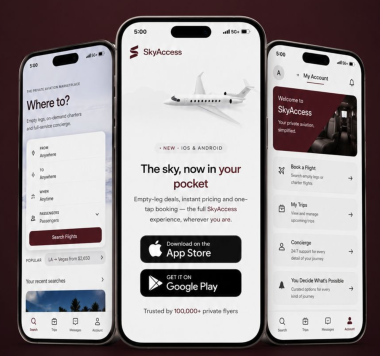
SkyAccess has recently launched a mobile app version of its marketplace platform.
‘Reroute Engine’
At the heart of the platform is SkyAccess’ so-called Reroute Engine which offers real-time flight availability. Buriev uses the example of a cross-country flight from LA to New York. “The chance that somebody would need to fly from LA to New York on Friday at 3pm is pretty low, but there are about 10,000 different variations of the route that the jet could take,” he said.
“The issue was that those cross-country one-ways would most of the time appear super close to departure, and by the time it gets to the WhatsApp groups it has already taken off. It was clear to us that the only way to make it work was to have real-time availability – a tech-enabled marketplace platform. That’s what we did, and now pretty much any long-haul flight can be rerouted, with the variations generated automatically.”
This algorithm and all of the software that makes up the product has been developed in-house. “When you search for flights, say from LA to Vegas, we made it so fast that it calculates and ingests them into the search in real time, so you wouldn’t even notice whether it’s a direct empty leg or a reroute. The flexibility window is calculated because we integrate with the FMS, so crew duty is factored in and we make sure the departure window is accurate,” he said.
Behind that sits a team of about 20 data interns turning platform activity into pricing and reliability signals. “We have so much data, and, in our view, every search, every booking, every interaction on SkyAccess should make the platform better and more reliable,” said Buriev.
‘Operators are nuanced’
The challenge for SkyAccess is keeping it’s inventory updated in real time in a nuanced operator landscape — some have owned fleets, some a floating fleet, some managed. Buriev’s team have found that aircraft managers often are locked into agreements with owners.
“Contracts that say, don’t let anybody on my aircraft for less than $10,000 an hour, and don’t do anything less than 60 minutes per leg,” he said.
SkyAccess’ answer is to give operators control of their own pricing rather than ask them to abandon it. Operators can build conditional pricing rules on the platform. “If it’s a Friday and it’s going from LA to Vegas, then charge $10,000 minimum. Done,” said Buriev. “And as the requests start coming in, we learn from each one, so every request gets more accurate and closer to what the operator is expecting.”
Despite the variations, Buriev presents the case for SkyAccess simply. Pick two operators, Operator A and Operator B. “A shares the vision that any dollar on top of zero is technically a net positive, so it is willing to sell those flights. B says it will not let anybody on its aircraft for less than $10,000, so it rarely gets booked,” he said. “One year later, Operator A nets $1m extra cash. Over ten years, what is Operator A going to do with that $10m? They’re going to buy more planes, offer better perks to existing customers, potentially offer better rates, have more flexibility and invest in refurbishing their planes.”
He also said he understands that not every operator is a fit for the platform. “But the long-term vision is for SkyAccess to be a full-on booking platform that will not only help travellers but also roll out tools to travel agents and brokers, and help operators with recovery. We don’t think repositioning flights are being utilised to their full capacity.”
Targeting one million users
Buriev said SkyAccess’ conversion rate speaks for itself. The industry average is typically 2–3% from the amount of quotes sent. Where an operator confirms the quoted price on the platform, conversion averages around 30%. “That comes back to the idea that SkyAccess is trying to answer: can private jets be priced accurately without a request for quote, with the actual price shown beforehand? That’s the answer we are solving,” he said.
Looking ahead to the next 17 months in business, Buriev would like to see over one million active users and at least 80% of global empty leg supply. He would also like to see SkyAccess achieve a 99% reliability score for listings converting to confirmed flights if they are booked.
“The long-term vision is that SkyAccess becomes the default go-to place for booking private jets, period,” he said. “We see it as: if a human can do it, it can really be automated. We are here to deliver tools that will empower them and enable operators to scale massively. It will be about operators that adapt and operators that don’t, because the output will be completely different between the two – like comparing two people, one using ChatGPT to write a book and the other not.”