
Corporate Angel Network: ‘We want to be like Ted Lasso’
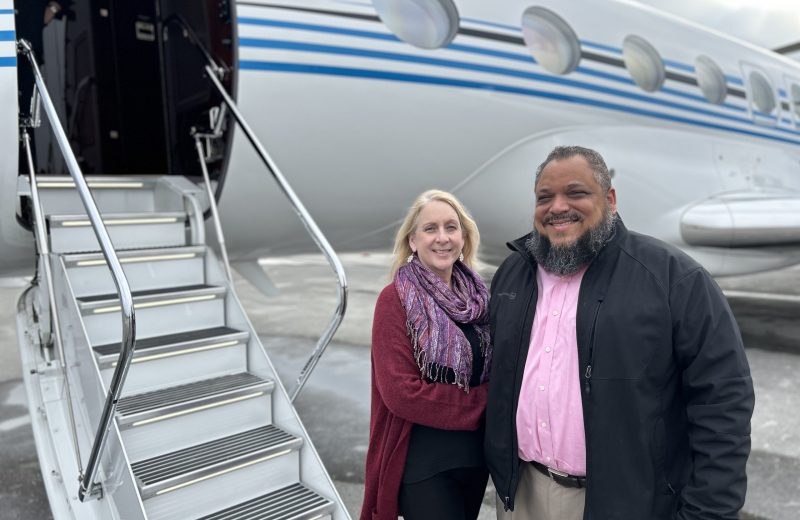
Nick and his wife prepare to board a CAN-organised corporate flight home after cancer treatment in New York City.
Corporate Angel Network – the charity that matches cancer patients needing transport to and from medical centres with the scheduled missions of corporate flight departments – has an unlikely role model. “We want to be like Ted Lasso,” according to Courtney Easton, vice president of Development at the charity.
Easton is referring to the fictional US soccer coach of the hit Apple TV+ series of the same name. At first sight, Lasso seems an unlikely choice for the charity (CAN). But within Lasso’s relentless optimism, empathy and relationship-based coaching philosophy, the charity draws inspiration for its mission.
Easton is referring to the fictional US soccer coach of the hit Apple TV+ series of the same name. At first sight, it seems an unlikely role model for the charity (CAN). But within Lasso’s relentless optimism, empathy and relationship-based coaching philosophy, the charity draws inspiration for its mission.
“The organisation wants to be here, there and everywhere – like Ted Lasso,” Easton tells CJI magazine. “We want to be everywhere that business aviation is to grow and ensure flight departments are aware of us and that cancer patients know that we’re here too as a resource.”
Operating throughout North America, the charity has just two rules. The aircraft – whether jets or more recently turboprops – must be pressurised, for medical reasons, and operated by two pilots on each flight.
“CAN exists to ensure that no cancer patients are prevented from receiving life-saving care because of the cost or the complexity of the travel they need,” says Easton. “So, we match open seats on business aircraft with patients needing to reach treatment at no cost to the patient or the corporation.”
Easton is keen to stress these are not dedicated flights – they fit within existing corporate travel plans. “Our model is that executives are already flying around the country and typically they have open seats on board,” she says. “We simply ask them to give those seats to a patient and a caregiver.”
1,800 patient flights a year
The answer for many flight departments is a resounding: Yes. The charity organises about 1,800 patient flights each year. But that’s fewer than half of the more than 4,100 flight requests received. All patient transfer requests are treated equally – there is no means testing of patients. “We will try to help anyone with a cancer diagnosis who needs a flight, regardless of their personal circumstances,” explains Easton. “We will help them as many times as they need to fly – from their initial diagnosis all the way through their treatment – even after they become cancer free.”
Patients of all ages – from 1 month to 92 years old – have benefited from the charity’s help. The first flight took place on December 22nd, 1981, when Safe Flight Instruments of White Plains, New York carried a patient home to Detroit after treatment in New York City.
Since then, the charity has worked with more than 500 corporations and occasionally wealthy individuals who want to use their personal aircraft to transport patients. CAN partners with flight departments from Alaska to the Deep South but it’s constantly looking for new partners to help meet patient flight requests.
Key IT enablers of the charity’s work are the bespoke software package called CueTree coupled with flight sharing software like BART, PFM, CAMP, FOS and Tripplanning.biz. Together, they enable the charity to sift thousands of corporate flight plans to match them with patient requests. “We are super lucky to have this automatic feed system that tells us the date and time of corporate flights for us to match with passenger requests. There’s no extra work put on the plates of the partners that we’re working with.”
Easton describes the charity’s workforce as “small but mighty”. It currently employs five full-time staff and three volunteers who work part time. Also, there are about 27 ambassadors for the charity – a project launched by charity’s president and CEO Robert Stangarone last year.
Funding is supplied by corporate and individual donations supplemented by the charity’s annual fundraising event called Fund an Angel. Typically taking place during the NBAA Business Aviation Convention & Exhibition (NBAA-BACE), the event gathers donations through corporate sponsorships, winning bids on auction items – such as holiday vacation packages, aviation memorabilia and ticket purchases for the evening reception.
Impacted by cancer
Donations are also made by families who have been directly impacted by cancer. Plus, the charity benefits from free media promotion in publications such as CJI.
Companies are motivated to support the charity with flights not simply “out of the kindness of their hearts”, says Easton – although that remains an important factor. Many corporate flight departments want to help as part of their corporate social responsibility mission. It also helps to build team morale, she says, after interviewing a range of corporate companies, as part of a promotional video project.
After attending National Business Aviation Association’s (NBAA’s) Schedulers & Dispatchers conferences, Easton reports delegates “with tears in their eyes” thanking the charity for the opportunity to help cancer patients. “They were very moved by the opportunity to help cancer patents because so many families are touched by the illness,” she adds.
Often, corporate partners support the charity without public recognition. “No one knows that companies are doing this, so it’s all happening behind the scenes,” says Easton. “That’s really a testament to how these organisations want to give back, even if the public doesn’t know about it. Many request anonymity. We would love to shout it from the rooftops, but we understand and respect requests for anonymity.”
So, any help the charity receives in promoting its work is welcome, according to the organisation. “Many cancer patients still don’t know that this service exists, and really allow us to reach more people who are looking for that help,” Easton tells us.
A key recent development has been opening up aircraft eligibility to include pressurised turboprop aircraft. “This brings an entirely new segment of operators who can potentially help our mission. Plus, there’s a significant opportunity in raising awareness.”
People who need support
Many cancer patients still don’t know that the charity’s free transport service exists. To remedy that CAN is working to strengthen partnerships with hospitals, cancer centres and support groups to reach more people who need help. Similarly, new entrants to business aviation are often unaware of the charity.
Easton sums up the charity’s proposition to the industry like this: “The business aviation community has the power to save lives simply by offering open seats on flights they are already operating. My hope is that readers walk away thinking: ‘We should be part of this – how do we get involved?’”.
So, perhaps Ted Lasso is a less surprising role model for the charity than might be expected. Borrowing Lasso’s determination to beat seemingly unbeatable odds, forge partnerships and easy charm could well inspire the organisation to recruit more corporate flight departments to help more cancer patients.
This article was first published in Corporate Jet Investor H1 2026 magazine. Click the link to read the full digital version of this article, which includes the experiences of pilots supplying CAN flights from Honeywell and Hanson Communications. Or sign up for your free hard copy of the magazine here.
Meanwhile, read on to discover how one patient values such flights and how you can help the charity’s work.
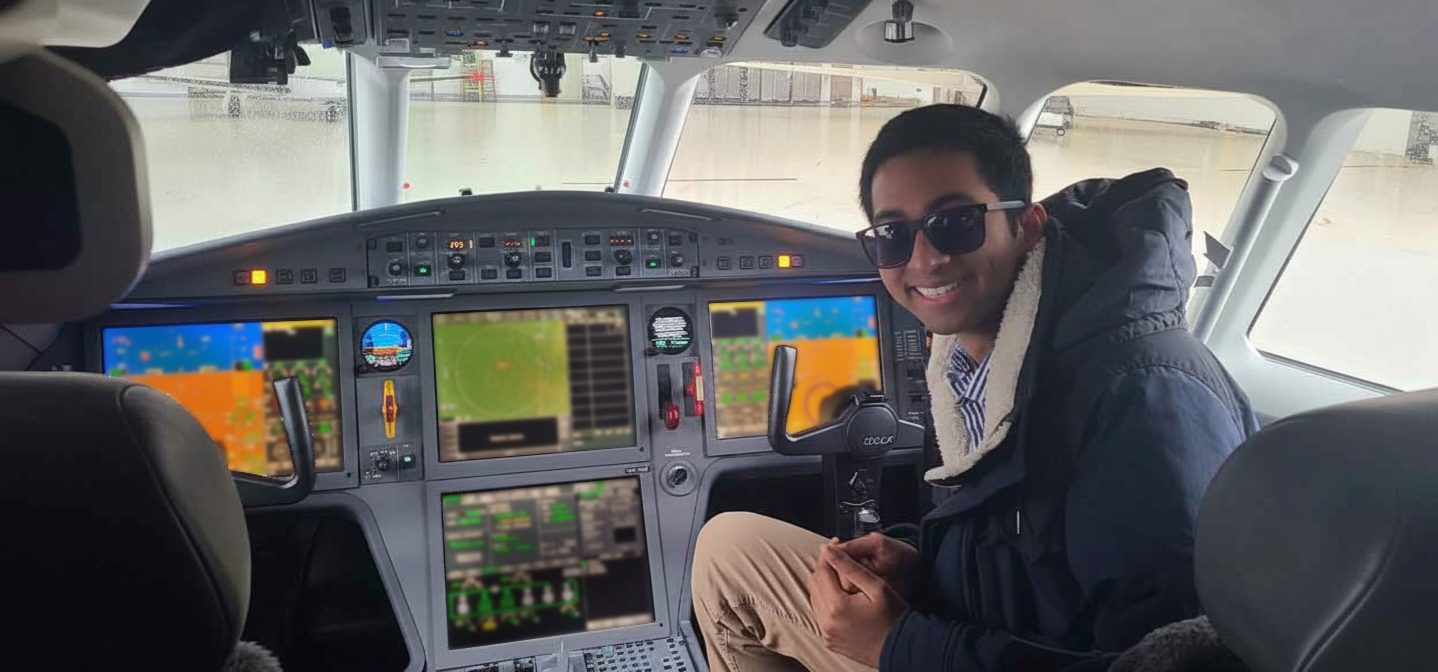
CAN flights mean far more to cancer patient Rahul than simply free travel to and from medical appointments.
A patient’s perspective
Flights to and from medical treatment, organised by Corporate Angel Network (CAN), were not just an economic and medical necessity but life-affirming for 24-year-old cancer patient Rahul. (We are withholding his full name to protect his privacy).
“Since the very beginning of my diagnosis, I was adamant that my family should not be further burdened by my diagnosis when it came to paying for treatment and travel,” Rahul tells CJI. “I can only imagine having a child who is going through something like this is enough of a burden.”
Rahul has been forced to put his studies as an aerospace engineering student “on the backburner” after his diagnosis. But, at least, his concerns about money have been mitigated by the free flights that CAN organised. “The fact that I’m still on a student budget does not help in the slightest. Without the CAN flights. I would have had to fly on the cheapest ticket available,” he says.
But it’s not just about the money. Business jet travel afforded him the pain-free travel that would have been impossible flying with a commercial carrier. “As part of my cancer treatment, I have been having surgery on my knee, going through airport TSA [Transportation Security Administration] and being scrunched into the sardine can seats of your average commercial flight would have been absolutely excruciating.”
Rahul needs medical treatment at a specialist facility in Yale, Connecticut. To help, CAN has arranged numerous flights on Dassault Falcon 2000LXS and Dassault Falcon 900EX jets from airports in his home state of Georgia. “I never take these flights granted,” he tells us. “I am grateful to the corporations who flew me and to Corporate Angel Network for facilitating and allowing my family and I to fly with me.”
But there’s another reason CAN flights mean so much to Rahul. They reminded him of happy days studying for his Private Pilots Licence. “My favourite thing about my trip with Corporate Angel Network was being able to sit up front with the pilots for the entire duration of the flight from Georgia to Connecticut. Talking shop with them made me the happiest I had been in a long time. Sitting in the cockpit wearing an aviation headset talking to my ‘people’, listening to the radio chatter of ATC [Air Traffic Control] immersed me in the environment I used to enjoy so much before I got sick.”
Can you help?
Every year about 200,000 cancer patients travel 40 miles or more for life-saving medical treatment, according to the American Cancer Society. As this number grows every year, so does the need for donations and volunteer companies and individuals to help fly patients and their carers to and from the specialist medical centres that help them fight the disease.
If you would like to make a donation to support Corporate Angel Network or help by offering free places in a pressurised turboprop aircraft or jet with two pilots on a pre-existing route, please contact the charity at +1 914-328-1313 . Or email the charity here.