
Business aviation flights could form part of Google contrails trial
The trials will focus on minor altitude adjustments within standard flight operations, coordinated through standard air traffic control communication channels.
Business aviation flights passing through Shanwick airspace could form part of an oceanic airspace-scale trial aimed at reducing the climate impact of aviation contrails, according to Google.
The trial, known as Operation Blue Skies, has been launched by a UK-based consortium comprising Google, the UK Department for Transport, the Met Office, the UK’s leading provider of air traffic control services NATS, Contrails.org, Imperial College London and the University of Cambridge.
The operation is a £5m, 30-month programme, partly funded by £2.65m from the Department for Transport. It comprises two operational trials conducted during the winter months, across NATS-controlled Shanwick oceanic airspace, the eastern half of the North Atlantic corridor.
Keir Mather, UK Government Minister for Aviation, Maritime and Freight, said: “We’re partnering with Google to back British experts and innovators to find practical ways to make flying cleaner. This is a world-first, and it’s British ingenuity leading the way. By testing small tweaks to flight paths over the Atlantic, we can cut the vapour trails left behind by planes.”
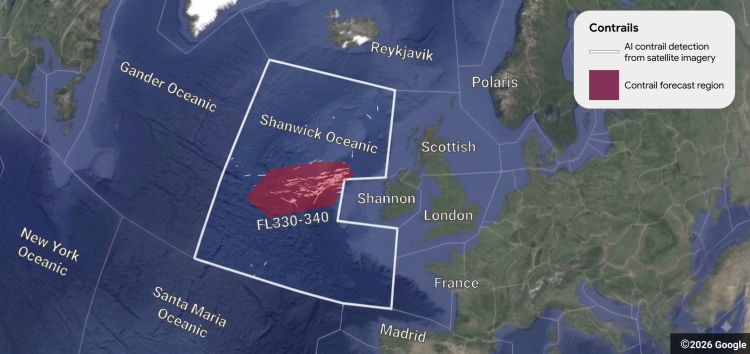
The programme will evaluate the feasibility and environmental benefits of adjusting the altitude of commercial flights to avoid atmospheric conditions that contribute to the formation of contrails. Google said atmospheric modelling shows that Shanwick airspace accounts for about 5% of global contrail warming and “a significant fraction of this warming is concentrated in the winter season” between November and February.
A notable impact on business aviation is not expected as part of the operation, however, the trial is not limited to commercial airlines.
Paul Hodgson, Google Technical Lead for Operation Blue Skies told CJI: “Private aviation will be part of this trial. In fact, all aircraft that pass through Shanwick are subject to NATS air traffic control, and as such could be deviated for contrail reasons — or any other reason, such as traffic — during test windows in the trial periods.”
A source with knowledge of the trial told CJI: “All civilian aircraft operating within the trial airspace may be included in the trial… We do not expect there to be notable impact on business aviation, as they typically fly at a higher flight level than where the contrail trial activity is expected to take place.”
The operation is designed to target the specific November to February window by using artificial intelligence (AI) models to work out where and when altitude changes could have the “greatest potential to reduce contrail-related climate impact”, according to Google.
The trials will focus on minor altitude adjustments within standard flight operations, coordinated through standard air traffic control communication channels. Trial manoeuvres will take place primarily during winter testing windows in 2026-2027 and 2027-2028, with between 20 to 40 test days per winter. Testing will be conducted during periods of lower air traffic.
Ian Jopson, director of Sustainability at NATS, added: “Decarbonising aviation will take a range of solutions, and understanding the role of contrails is an important part of that journey. This trial will allow us to test how contrail avoidance could work within the complex, highly coordinated environment of air traffic management.”